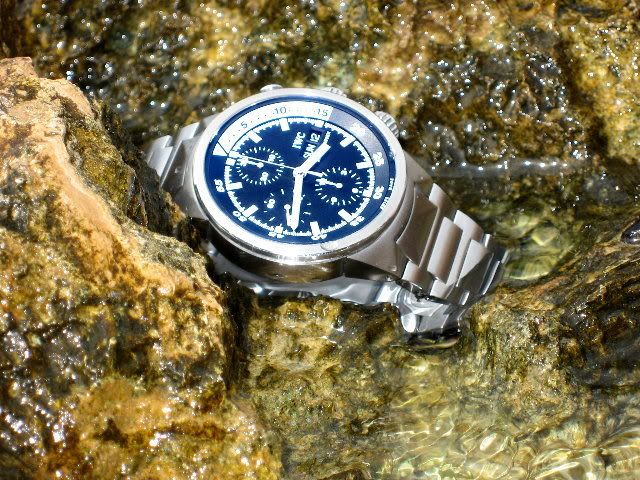
An oxymoron? Except relatively... (more)
Hi,
I saw your several posts elsewhere on the Internet raising the question, including relative to various other models.
First, I would respectfully suggest that no mechanical chronograph, by any company, is “ultimately” tough. It is a complicated watch, with user interaction. As such, it has more parts that can go out of whack compared to a simple watch. The stop/start/reset mechanisms and totalizer mechanisms are for all movements more “delicate” than a time-only watch. To that extent, your questions focusing on screw-down pushers or calendar mechanisms respectfully may miss the issue. The real vulnerabilities are different.
Second, I would suggest that without a definition of “tough” there’s no easy way to compare. Do you care more if a case gets scratched than if a watch loses 3 seconds a day if there’s a shock? There’s tough and there’s tough. And anecdotal reports really aren’t the solution.
I also would add that I never understood why anyone would want to wear any fine , very expensive, mechanical watch under extreme conditions. As I’ve written here, I used to see one of the Tour de France winners wearing a Cartier while on a bike. To me that seemed to be inviting a gash or expensive repair, both of which can easily be avoided by wearing a “CBP” (cheap black plastic) quartz watch.
That said, I will say that the Valjoux 7750 chronograph base movement is among the most durable and shock resistant chronograph movements ever made, although there are anecdotal reports that its chrono hand can sometimes (very rarely) reset off with shock. I also would say that IWC’s enhancements and assembly improve the movement substantially.
To read more about what IWC does to the Valjoux, please click on the link below.
Relative to the Daytona, I think the movement is probably as strong but the Daytona uses a free-sprung balance. That can avoid some time-keeping errors due to shocks, but the converse is that those are more difficult to adjust. I also think screw-down pushers do not add to shock protection, resilency, etc. I think they’re a pain and deisgn from the 1950s when water-resistant case-design engineering was weak.
I don’t consider the Valjoux to have a true “module: for a day/date, but more complications always mean there’s more to go wrong. That also is true for a rattrapante (dopplechrono) function. But the converse is that you do have the day and the date. Or two chronos, which in the instance of the Doppel means some utility but also a far greater horological achievement.
Finally, I believe far more is accomplished by case construction than movement. To that end, IWC’s ceramic cases can be proven to scratch less than steel. There’s no contest. But also a highly water resistant case is better than any steel case, and better than almost non-scratchable ceramic, if your definition of tough is “protected from outside elements” and you don't care about cosmetic scratches.
My vote is that the Aquatimer chronograph might be the toughest one on the market. But frankly I would buy any fine mechanical watch for its finess. And most are relatively tough enough.
Good luck.
Michael
[ ](www.iwcforum.com/)
click here for article