After reading a lot on AR coating.... I'm wondering why IWC doesn't use a polarized surface on there high end watch? I really like the way the watch looks with AR on the outside but after replacing the sapphire for the 2nd time at €€ I'm considering just to remove it all the way!
Is there a new more durable AR coating on new IWC models? (Omega uses new coating less blueish but more durable they say).
I never felt the need to replace the glass of any watch. All my watches have AR-coating, without any problems. But of course, I am quite careful with my watches. I'm just curious, why did you replace your glass?
Polarized watch crystal would create strong darkening on beveled areas and would darken the whole watch face. Also how and why are you planning on removing the AR coating from the factory supplied sapphire crystal?
I'm wearing my IWC PPC as a every day watch I sleep with it and only take it of when I shower or go swimming (because of the heat that might soften the AR coating) but after 1 year it shows a nasty scratched dot/spot between 1 and 2 hour mark that's growing!? The 1st AR coating on my IWC PPC sapphire was scratch after going to the beach and swimming in salt sea water. This isn't the only watch I've had this problem with I had the same problem on my 2005 Zenith El-Primero and my 2006 Breitling Superocean. I also own a 2001 Forum Calendrier with inside AR coating only and never had to replace the sapphire and it still looks like new. :)
PS I wear my IWC quite careful but had some accidental bumps.
Where do I begin. First, if you wear a watch to the beach, you stand a high probability of scratching an AR coating and in fact any crystal coated or not. AR coatings are softer than the crystal, but they are hard enough to stand up to most non abusive conditions. Wearing a watch to a sandy beach to me is abusive.
Second, a polarized coating would do nothing to reduce reflection and improve clarity. It fact depending on how you orient the polarized crystal, it will in fact reduce and filter light transmission. The back crystal on the magnificent Siderale has a polarized element to simulate day and nighttime conditions.
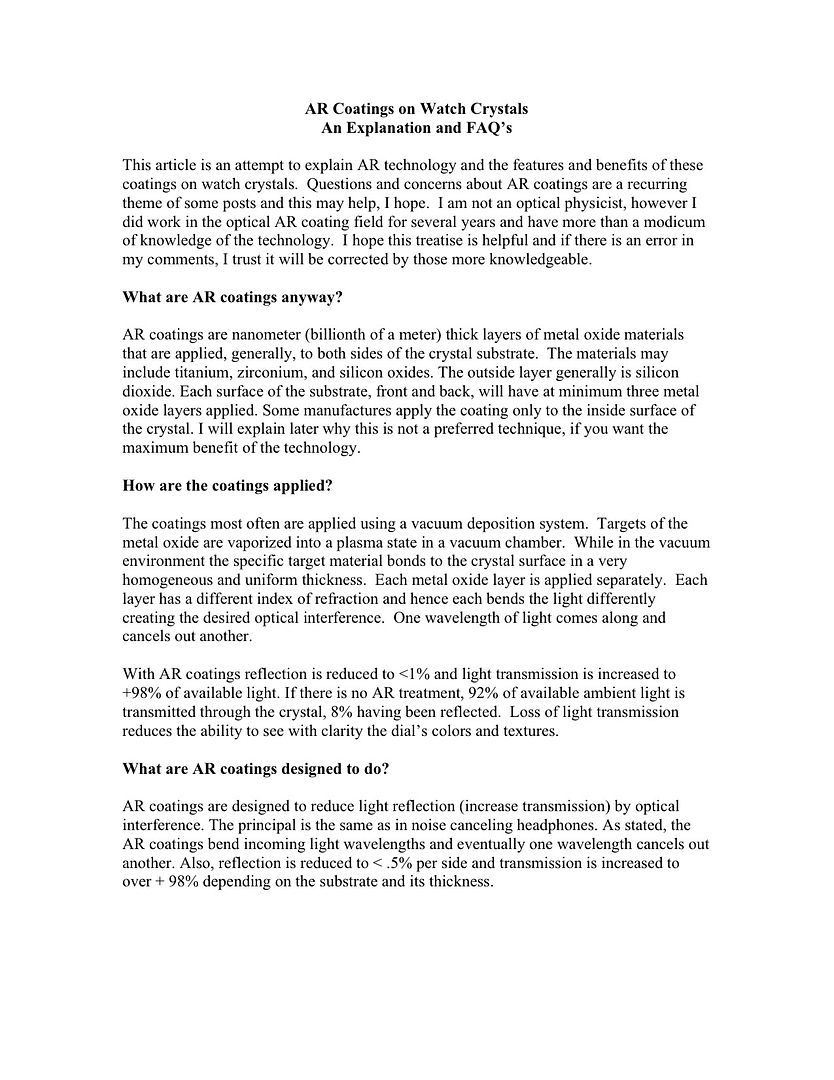
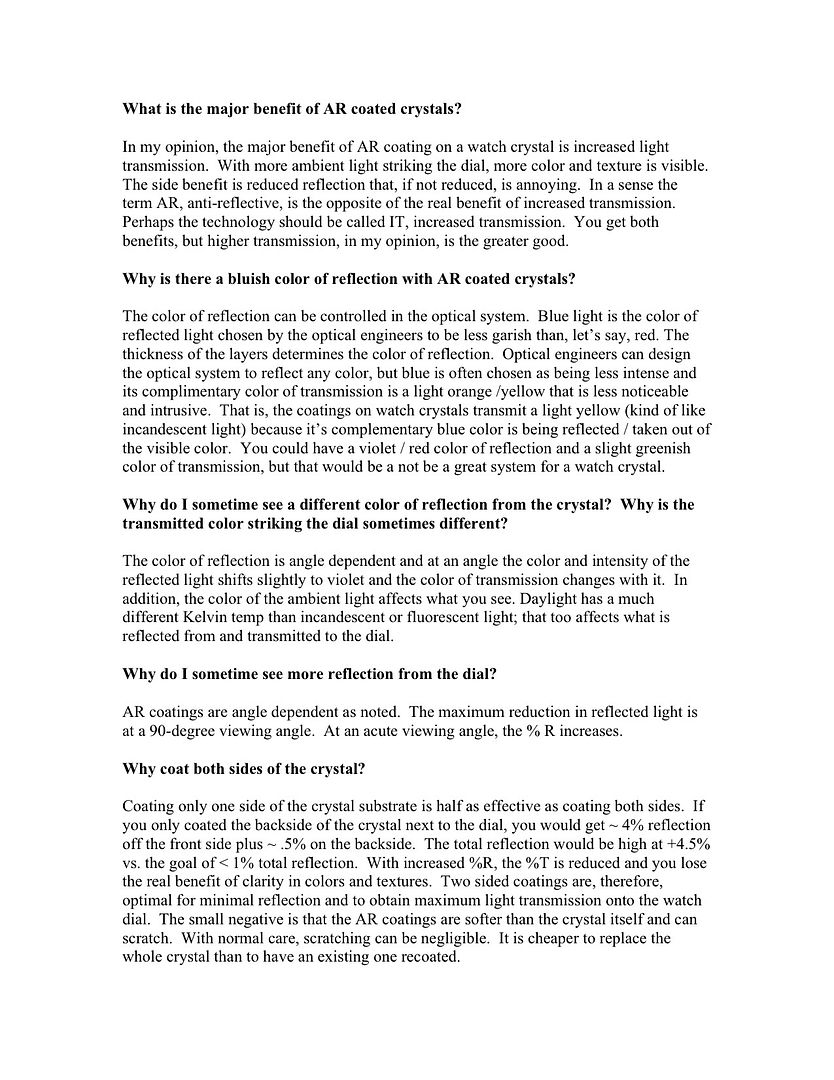
Here is an article I wrote some time ago explaining the features and benefits of AR coatings on watch crystals.
I'm just wondering why the IWC PPC AR coated sapphire is more expensive than a IWC Aquatimer AR coated sapphire? Is this beacause the watch is more expensive?....
In my opinion it's the same Sapphire and coating or not?
I realy love my IWC but IWC Sapphire prices are CRAZY!!!! comparing to other brands!
I don't know why one crystal is more expensive than another here, assuming it is, but sometimes this has to do with the size, shape and lip. Some crystals are standard (usually flat) while others are ordered from the manufacturer in custom shapes. I know on some models the custom, special-order fabrication can be quite costly. And that's not IWC's pricing but rather its supplier's.
The cost of the AR coating is not a big cost variable comparing one coated watch crystal to another. However, AR coating cost is not inexpensive. However, the higher the volume for a coated crystal, the lower the price. It is a batch process, so the longer the run with max capacity in each vacuum chamber the lower production costs. The size and shape are not a big issue in coating costs unless fewer crystals fit in each batch. I suspect, as MF points out, the production cost of the crystal itself, which is a function of its design, is the most significant cost factor differential.
I would not take a PPC on the beach or for playing with the kids in a sandpit nor for a swim in a lake or the sea nor on power boats or yachts. I might take it on a cruise liner so long as its not the Titanic or Costa Concordia. PPCs are not wet sand or salt water happy. Sand can easily scratch stainless steel and gold is far softer. Likewise AR coating will suffer from sand and salt water environments. It's why my camera lenses have filters on, to protect the front element from knocks and unwanted deposits including rain.
Thank you all for the explanation on AR coating! @ Bill and Michael I've asked my AD and he told me it has to do with volume the watch is produced however he's charging me more than double over a (standard) Aquatimer sapphire :( @ Greg why does IWC AR coat a Deep Two? Diving a swimming pool ain't that spectacular ;) LOL. I'm still wondering if there is any other technique to get the same result? PS Still in love with my IWC PPC there is nothing to beat it!!! But I love to get my hands on a sapphire for a (normal) price......
If the Deep two has AR coating I would be amazed if the coating was external unless the coating is as hard as the crystal. If its softer then sand and saltwater will do it no favours. Re crystal prices versus others is not for discussion on the forum as per forum rules.
Not Greg, but the reason to have two sided coating is to increase light transmission and allow more visible light to strike the dial and to allow more of the lume to be transmitted back to the eye. In diving, the more you can see the dial underwater, the better. Yes, the coating is softer than the crystal, but it's plenty hard. Just don't abuse it my hitting coral or hard objects or dragging the watch around in the sand.
This was an interesting thread, guys. I got to read Bill's AR article again, and the discussion was most enlightening! The expertise here never ceases to blow me away!
@ Bill After a good search and a lot of reading on AR coating I found out that there are different ways to get AR coating done. Do you know what method IWC is using? Do you have any experience with Laser AR coating on watch Sapphire? And what is "DurAr"?
Standard Anti-Reflection Coating Types:
*Single layer Anti-Reflection Coating (SLAR): most cost effective broadband
Laser Anti-Reflection Coating (v-coat): A.k.a. "V-coat" R(CWL)<0.1% typical Narrowband best for monochromatic applications Moderate precision
Broadband / Multi Layer Anti-Reflection Coating (BBAR / (MLAR): R(average)<0.5% typical over user defined spectral range High precision, for use "when every photon matters"
Yes, I am familiar with these. The single layer AR coating is most often used for solar and some picture framing applications. It has a very porous structure, latex is embedded in the coatings and burned off later to leave a structure that has AR properties. But, it is so soft it would not be appropriate for watch crystals. It is rarely used in batch applications, individual crystals. It is cheaper because it's a single layer and is done with mass production equipment producing millions of square meter glass.
The laser system as you describe answers it's own question. It is a narrow band AR coating that reflects a very narrow and specific wavelength, usually only a few nanometers. It is used for laser systems where you want high transmission in the laser wavelength and virtually none in the nearby wavelengths. Laser is not a coating system, it's the end result. TheLow reflection percent is posible because the system is designed to affect this very narrow wavelength of visible or non visible light. It would not be suitable for broadband sunlight that in the visible range covers the 400-700 nm range
The method with best broadband AR properties, low reflectiona and high transmission, with excellent durability / scratch resistance, is done with vacuum deposition equipment. It's a multiple layer system that maximizes the optical light interference. It's not an inexpensive process. I don't know for sure what IWC's supplieris doing, but with great certainty, it's a broadband AR system using vacuum deposition. There is a chemical system called sol-gel that does the same thing, but it is not possible to use this for batch items like a small watch crystal.