• Master
    28 Feb 2012, 8:05 p.m.

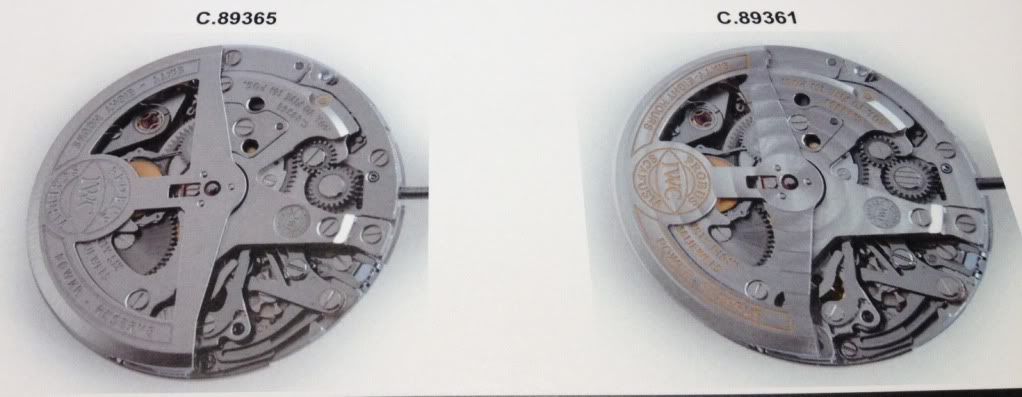
    Somewhere I saw a picture of what seems to be the 89365 movement of the Spitfire Chrono, along with the picture of the 89361 of the Portuguese Yacht Club. Quite noticeable was the lack of decoration of the 89365 when compared to the 89361: no Geneva stripes, no gold coloured inscription: the 89365 looked a bit naked. I am almost sure it is no fake, the two movements looked identical apart from the decoration.

    Although it should not matter to the quality of the movement itself I think it is a bit of a pity, as most IWC movements are decorated in a traditional way, even when the movements are not visible through a see-through back. Is there any reason why IWC has waived the decoration of this movement? Will this be the new standard for other movements too?

    Kind regards,
    Paul

  • Master
    28 Feb 2012, 8:21 p.m.

    Is this the picture you are referring to?

    i69.photobucket.com/albums/i49/lndblr/CaliberComparison.jpg

  • Master
    28 Feb 2012, 8:41 p.m.

    The reason is probably down to display back on the YC but not the Spit, therefore why decorate what can not be seen? It is after all supposedly a practical watch aimed for potential magnetic situations. Stripes and the like are decoration and whilst pleasing to the eye they are candy floss for the eye and serve no practical purpose that I know of.

  • Master
    28 Feb 2012, 9:05 p.m.

    Because that's the way to do things right, otherwise, what reason to call it haut horologerie?

    If it might happen to someone to open up the case, let's say for instance, of a Patek from the '50s or a Vacheron, he will find most parts not visible, superbly polished.

    I guess the amazement of the lucky viewer defines the mark between something worth to keep forever and something not.

    BTW, IWCs from the '50 to my little knowledge were superbly polished as well.

  • Master
    28 Feb 2012, 9:29 p.m.

    I agree 100% with Roberto.

    • Tracy
  • Insider
    28 Feb 2012, 9:33 p.m.

    Certainly most of my vintage IWC wrist and pocket watches have beautifully decorated movements. These also don't have display backs to show that beauty!

    Makes me appreciate them all the more!

  • Master
    28 Feb 2012, 9:59 p.m.

    Just one example:
    h-bertram.homepage.t-online.de/scara.jpg

  • Master
    28 Feb 2012, 10:20 p.m.

    That's a pity to learn if this is confirmed. The decoration is fine examples of craftmanship.

  • Master
    28 Feb 2012, 10:53 p.m.

    Here is an example of Haute Horologerie.

    www.danielslondon.com or search for Roger Smith watches.

    Geneva stripes are hardly standard on the above examples because they are not making Swiss styled watches and nor are A Lange or Panerai or English PW from the 18/19 century. But does that exclude them from being HH?
    Even PP are using non traditional materials now in some of their higher end models, some of these components do not lend themselves to decoration. Are you removing such models as not being HH?

  • Master
    28 Feb 2012, 11:50 p.m.

    Caliber 94900 is not decorated. Just thought you'd like to know that it is not used in basic or simple models, just the Siderale! But according to some this does not qualify as HH because it's not decorated! The pinnacle of IWC output is not HH by the presented argument!

  • Connoisseur
    28 Feb 2012, 11:58 p.m.

    While I personally like exquisite finishing, I think there is a trend at IWC to have an "engineered" look --very functional. Also keep in mind that IWC didn't use Geneva stripes, etc. on many of its great pocket watches, at least for the first 50 years minus a few instances.

    As much as I truly respect Hebe, I will say something possibly in a small minority....I think the finishing of the Scarabaeus is not "exquisite". To me the big swirls are somewhat crude (compared to other movement decorations by some others) and also have little functional purposes (anglage, stripes, etc. in theory do).

    I suspect the calibre 89365, like its more limited counter mechanism, was built to a price --and there's nothing wrong with that. And there is something to be said for functional engineering as a philosophic statement. It's just not as pretty.

  • Master
    29 Feb 2012, 12:08 a.m.

    Greg, I took license to quote part of your comment just because it gave me the chance to talk polishings, nothing personal :)

    The example of Roger Smith (one of the independent watchmakers I admire the most) you're bringing to attention is very pertinent.

    You won't see cotes de Geneve (Geneva stripes) because they're not part of english watchmaking tradition, that's true.

    Even if I guess everybody already knows, I would like to point out there's a significant difference between decorations and polishings.

    Any type of polishing was born with the intention to provide protection to the movement (to dust, to eliminate traces of metal works imperfections etc.) and then the art of polishing became a specific skill in the art of watchmaking, accordingly to all the activities made to embellish the movement, like decorations (engravings etc.).

    Thanks to the development of technology, especially in sealing the case making it protected to dust, water etc. polishing did loose most part of its functional role but just part of it, it still maintains its functional role to preserve the movement and its functioning.

    Coming back to the RS example, you won't see Geneva stripes but you will see a perfect chamfrein or anglage, surfaces are highly polished (black polishing), mainplates are often highly decorated (ciselage), chatons hosting the stones are magnificently polished with the oeil de perdrix technique.

    At the end, only an ignorant or someone in badfaith could affirm RS's watches are not haute horologerie as the same person with same intentions could say the movement firstly posted shares same high end level of polishings of any RS's watch.

  • Master
    29 Feb 2012, 12:23 a.m.

    Roberto, I went to the retrospective exhibition of George Daniels work in 2006, every PW he ever made bar one was there, his adaptations of everyday Rolex and PP WW models fitted with his escapment were there too. But it was his PW collection which were jaw dropping pieces and I managed to get him to sign the catalogue. A masterpiece of photography in itself. Sadly it's not obtainable new as the surplus were pulped. I have yet to see one on Amazon or eBay.

  • Master
    29 Feb 2012, 12:40 a.m.

    A Master and a genius he was.

    I lately had the chance to see some Dent pocket watches instead, superb!

  • Master
    29 Feb 2012, 12:58 a.m.

    Bet Dent did not sign anything for you, Roberto!

    I have tried to think of a way of copying the Daniels catalogue, by photography or scanning, but not wishing to break the spine I am thwarted thus far, it's like most auction catalogues of less than 1cm height so if anyone has an idea then please email me. I have no doubt Tracy would find the answer and do a cracking job with the help of something from his thrift shop! But I can hardly risk the catalogue on such a postal journey, let alone what postman do to cram it in the letter box at either end of the journey.

  • Master
    29 Feb 2012, 1:22 a.m.

    Until now I considered anglage and stripes, and maybe perlage too, just decoration, nothing else. What are the, maybe only theoretical, functional purposes of them? I even thought that, for instance stripes, could leave minuscule particles behind that might interfere with the movement, I thought that high-class polishing would be THE measure against it. That being one reason to maybe even like the no-nonsense look of the 89365.

    Kind regards,
    Paul

  • Connoisseur
    29 Feb 2012, 1:25 a.m.

    Guys, I love Dent and Daniels and Smith and dozens of artisan watchmakers. And I love some of the finishing by IWC's sister companies including Dubuis, Lange and Vacheron. But --this is an IWC forum and we've got to bring the discussion back to IWC. And I love IWC too.

    Thanks.

  • Connoisseur
    29 Feb 2012, 3:15 a.m.

    Sunflower/Paul,

    I'll stand corrected on stripes. In and of themselves they are decorative, although the polishing is not.

    The person who I learned most about the technical aspects of watches, Walt Odets, who is a good friend, wrote this over 14 years ago about watch finishing:

    Date: Sun, 21 Dec 1997
    From: Walt Odets

    Of the four items Val Joux lists, only one is really a measure of movement finish, the "polishing of parts." Blued steel screws, engraving on the rotor, and "gold" (or, more usually gilt) may be aspects of fine movements, but today are more likely to be relatively cheap shortcuts to give movements a distinctive look. Almost everyone who uses the ETA 2892 these days engraves and gilts the rotor, and many also use blued screws. These don't, in themselves, add up to a beautifully finished movement.

    Among the criteria to judge the finish of a movement:

    Bridge surfaces may be roughly smoothed (in very cheap movements), gilt, or (in the best movements) rhodium plated. Before plating, bridges in high quality movements are decorated with various patterns. The best known pattern is the Geneva Bars (or cotes de Geneve) and the less costly perlage (swirls of overlapping circles). The bridges on the best movements have extremely smooth surfaces, bevelled edges (anglage), recessed screws with polished surfaces on the recesses (this called "moulding" or oeil de perdrix). The plating should be almost white, not gray or yellow, and without stains or scratches. The spacing between bridges should also be regular.
    All screws should be polished. In order from good to best, screws will be: flat-polished; polished, chamfered screws (anglage between the polished top surface and burnished sides of the screw); flat-polished, chamfered outer edges, and chamfered slot edges. The heads of the screws should be absolutely level with the bridge surfaces (excluding screws whose function relies on projection above the surface, such as balance regulator screws).
    All exposed steel parts (click, regulator lever, etc.) are polished, and in the best watches, the polish should be "black," giving a deep, glossy finish. Poorly polished parts are gray in appearance. The quality of the polishing is a product of a complete lack of any marks or unevenness of the surface. The best work also burnishes and rounds the edges of these parts.
    The finish on the ratchets and wheels is important. In increasing order of quality (more or less), there are voluted ratchets (a spiral pattern or other design running out from the center); voluted ratchets with bevelled toothing (polished, chamfered edge on the toothing); "large gouge volutes" (a star-like pattern of lines radiating out from the center) and stopping ashort distance from the outer edge and bevelled toothing; "diamante" finishing (a moire-like surface) and bevelled toothing.
    The finish of a movement is enhanced by good quality jewels which are well set in the plate or bridge (or attached). Stones of darkest color and clarity are most desirable. (In the synthetic rubies used in almost all watches today, coloring is achieved by adding chromium oxide to the aluminum oxide and the purity of ingredients determines clarity). When the jewel is set directly into the plate or bridge (friction jewelling), it is set into a hollow with sloping sides (the "decouverture"), which must be perfectly burnished in the best movements (this enhances the brilliance ofthe jewel). Jewels may also be set in "chatons." Instead of setting the jewel in a hole drilled in the plate, the jewel is set in a ring (the chaton, often made of gold) and the chaton is screwed to the plate. The shape of the jewels, the shape of the holes in the jewels, and the use of jewels in pairs ("cap" jewels or "combined" jewels) are important in determining the quality of the movement, but more a matter of function than finish. Diamond, instead of ruby, may also be used for cap jewels.
    The "non-visible" parts of the movement (on examination with the movement in the case, with the back removed) are as well finished as the "visible" parts. The bottom of the plate (the surface and motion works under the dial) is especially revealing of movements that are well finished.
    Engraving ("chasing") of bridge surfaces entails a great deal of handwork and, to some, enhances the beauty of a movement. I usually find it unattractive and superfluous in an otherwise beautifully finished movement. Chasing often detracts from the perception of the function of a movement.
    Really beautiful movements, finished as I have described above, have an immediate and unmistakable appearance on visual inspection. The perfect color, gloss, and sheen, seen even with the naked eye, gives the movement an immaculate, silvery, almost ethereal quality. This kind of appearance is the product of many fine operations. As I have said before, judgement about the quality of finish of a movement (or the quality of its design and construction, which are different issues) can only be learned by looking at movements. The naked eye, a 4 power loupe, and a 10 power loupe will each reveal different aspects of finish and quality, all important to the watchmaker.

    One should start by looking at really fine movements to develop a standard. Among all current manufacturers, Patek, Audemars, Lange, and JLC (in approximately that order, I would say) are the only firms consistently adhering to the highest standards of aesthetic finish. (Others are taking more "pragmatic" approaches to finishing, but may be producing functionally excellent movements. IWC is an interesting example because in using JLC movements, IWC finishes them to a much lower standard.

    Visually compare a gold Geographique with a "small" Portugese. Both have a sapphire back.) It should be obvious from this description of finish that blued screws, gilt surfaces, or an engraved rotor do not constitute good finish of a movement. In the current marketing climate (with such heightened awareness about mechanical movements), such cheap efforts at the appearance of quality have become common. It is amazing what manufacturers are now willing to reveal under a sapphire back. Once you have looked at beautiful movements, many of these will look downright ugly.

  • Master
    29 Feb 2012, 9:29 a.m.

    MIchael, that is a very good explanation of the way HH watches qualify to HH status. I am surprised VC does not make the list.

    With regard to the Siderale do you know why it is "battleship grey" rather than carry any components plates bridges wheels or hair springs that I can see that are polished or decorated. It is a tour de force but it's movement has zero beauty to behold. Not that I'll ever own one!

  • Master
    29 Feb 2012, 3:10 p.m.

    Dear Forunmers,

    I've read with interest the arguments pro and con and would like to chime in with some personal observations.

    Just as IWC's calibre C884/2, used in Mark XII timepieces, were produced in a simple matte nickel finish with no patterns so, too, IWC has chosen to produce a similar micro-blasted nickel plated finish for their calibre C89365. This, rather than a decorated movement, emphasizes and focuses on functionality more than aesthetics and which movements may be reserved primarily for cases covered with a metal back.

    The above mentioned C884/2 movement for the Mark XII was produced by IWC's sister company JLC. They also produced for IWC the equivalent calibre C887, beautifully gilded and decorated, which can be found in timepieces with an exhibitionist case back.

    Also, going back in time over many decades, IWC outfitted other models with simple non-decorated movements.

    The calibre C89365 is a more elementary version of the calibre C89361.The chronograph counts only seconds and minutes (the other movements of this family are counting seconds, minutes and hours) – which also means that this movement has fewer wheels than the others.

    While decorating a movement enhances its look and prestige, having a simple but well engineered movement produced in-house is a valuable contribution of its own. Coupled with other non-technical considerations I think IWC positions their products carefully without trying to emulate other high end luxury brands.

    Regards,
    Jack Freedman