• Apprentice
    7 Jul 2012, 8:23 a.m.

    I bought a new Spitfire Chrono that uses a new in-house movement, cal.89365 last week. I'm still in doubt about the difference between cal.89365 and Valjoux 7750 that was used in old version. Does anybody explore the mechanism, materials, innovation, not just about function? I've not seen any details on IWC web site.

    I bought this watch because of an attractive design, not in-house movement. I don't care. It's not my concern. I just proud they use their own movement.

    Many people says Hublot clone the Valjoux 7750 architecture and then adjust some mechanism and change some materials and then speak out loud "It's the first in-house movement".

    That's why I'd like to know more about the deep details of cal.89365.

  • Apprentice
    7 Jul 2012, 8:34 a.m.

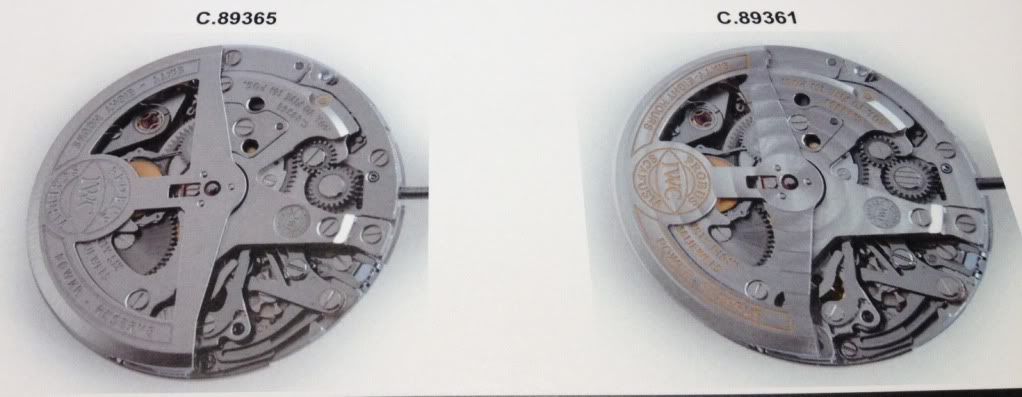
    I knew it has a brother, cal.89361 but cannot find the deep details about movement.

  • Master
    7 Jul 2012, 8:52 a.m.

    Hi,

    duration of power reserve would be one. some (non-exhaustive) information on other differences below:

    89361 vs 89365:
    www.iwc.com/forum/en/discussion/49800/
    i69.photobucket.com/albums/i49/lndblr/CaliberComparison.jpg

    www.iwc.com/forum/en/discussion/57252/?page=2

  • Master
    7 Jul 2012, 9:04 a.m.

    The 89365 is inhouse, it has a flyback mechanism, the "watch in watch" feature wich is showing hours and minutes in the same dial like a second watch. Unfortunately the new Spitfire Pilot's chrono doesn't have that hour counting hand. And it has 68 hours power reserve instead of 44 in the 7750. But the 7750 had the day of week display that the 8936x doesn't feature. That display I liked a lot.

  • Connoisseur
    7 Jul 2012, 2:32 p.m.

    I haven't checked but when the 89360 came out with the Da Vinci I'm sure there were posts about it. It is totally different in design than a 7750, of which the first difference is that it uses a column wheel for the Chrono functions, rather than what essentially is a spring mechanism. That is more traditional, more costly and avoids a jump on starting. You can Google column wheel and learn much more about what it is.

    It also has an innovative counter system ad the vertical clutch entioned below, as well as a different winding system. Also the parts are more in general.

    You'll need to do a little research in the archives and the Net, but aside from both being echanical chronographs that tell elapsed time, and use a so-called Swiss lever escapement (as do virtually all mechanical watches) they really have nothing in common from a design perspective.

  • Connoisseur
    7 Jul 2012, 5:36 p.m.

    To supplement what I wrote, here's onr prior duscussion about the 89360, the predecessor of your movement:
    www.iwc.com/forum/en/discussion/16776/?page=1#post_193316

    Among other characteristics it has a special winding system, a special shock absorber and a free-sprung balance. The latter is particularly important since regulation can be finer and the timing goes less out of whack (another search on free-sprung balances will help). That's in addition to the column wheel and longer autonomy, among other characteristics.

  • Master
    8 Jul 2012, 1:32 a.m.

    There are at least two benefits with the new in-house movement:
    1. longer power reserve
    2. flyback function

    I think it is essentially a replacement of the preivous IWC-modified 7750 movement, the 79350.

  • Apprentice
    8 Jul 2012, 6:41 a.m.

    That being said, when the Spitfire chrono needs service overhaul/cleaning, will it be sent to Schaffhausen to have it done instead of in local area, like, in the U.S.just to maintain its being an in-house movement?

  • Apprentice
    8 Jul 2012, 9:11 a.m.

    Thank you all...

    And YESSSS.... thank you Michael, this is what I want to hear that this movement uses a vertical clutch and column wheel!!! That's amazing. One is an innovation to control the chronograph hand like in many modern chronograph watches and one is a traditional chronograph style.

    A column wheel is a very complex mechanism. I had a column wheeled chronograph watches: PanoGraph, Datograph, Master Compressor Chronograph, PAM275, Zenith Striking 10th... this traditional style reflects the innovation from the past and more attractive when seeing through the transparent case back. But for cal.89365 I cannot see the movement from the case back and there's less details about this movement on catalog and web site. I think IWC should provide a much more details of their movements to get more user experiences from their customers.

    Sample technical details I would like them to show:
    - balance wheel?
    - escapement?
    - main spring?
    - clutch?
    - base movement architecture?
    - decoration?
    etc.
    Because I think these will help them to get more user experiences. I know this is not a complicated watch like minute repeater or perpetual calendar that they usually show the inside, but some customer like me probably want to know what is inside the case and behind the design.

    Anyway, I love a vertical clutch & column wheel... It's enough :)

  • Master
    8 Jul 2012, 10:50 a.m.

    Hi,

    I like to point out this thing because I think it's peculiar to this calibre.

    Cal 89360 uses a (huge) column weel (and that's to avoid typical backlash when activating the chronograph funcions in, f.i. an horizontal column wheel chronograph) but the column wheel comands a sliding pinion, not a vertical clutch.

    This is to keep the movement faithful to one of its main specifications and goals, which is not to lose amplitude while engaging the chrono functions.

    In vertical clutch mechanism you'll have to confront with loss of amplitude when the chrono functions are off, due to friction between clutch rim and arms, this is not going to happen with IWC's solution which allows to counterbalance instead, the loss of amplitude when activating the column wheel, thanks to the peculiar design of the chrono functions and its energy clearing system.

    The following is just an example of a vertical clutch, system you won't find inside cal. 89360.

    i294.photobucket.com/albums/mm101/flyrobyfly/Host/2c0b3c74.jpg

    If a found a detailed picture of calibre 89360, it would be simplier to show the differences.

    Hope this helps anyway :)

  • Connoisseur
    18 Oct 2012, 3:56 a.m.

    I know this is an old thread, but please people...
    In normal language what does this mean for my Spitfire?

  • Master
    18 Oct 2012, 4:18 a.m.

    your Spitfire: cheaper, less power reserve, not-inhouse-movement.

    besides that, everything else is the same (without going into too much details / distinguishing points) !

    I love all of my pilots with Valjoux 7750 (or its predecessors/successors)...

    i1120.photobucket.com/albums/l497/vanhalen812/3799/379901TopGun37053717-14PatrouilleSuisse5Aug121.jpg
    i1120.photobucket.com/albums/l497/vanhalen812/3799/379901TopGun37053717-14PatrouilleSuisse5Aug122ndset11.jpg

    and am considering the steel version of this St Expuery edition 2012 - although not a 'Spitfire per se' - with cal 89361 (because I don't have a pilot's watch/case containing this movement':

    www.iwc.com/en/collection/pilots/pilots-watch-chronograph-edition-antoine-de-saint-/

    i1120.photobucket.com/albums/l497/vanhalen812/St%20Ex%20Chrono%20red%20gold%20500%20pcs%202012%20ref%20387805/StExredgoldchrono2012refLE500pcs3878056.jpg

  • Connoisseur
    18 Oct 2012, 9:31 a.m.

    Sorry Shing, so the 89365 is the cheaper version of movement, although in-house and being sold at higher premium? I'm lost.. verticle clutch, sliding pinion and all.. just happy to see the time on an IWC

    **nice collection of Chrono's though

  • Master
    18 Oct 2012, 12:32 p.m.

    No WJ, the Valjoux 7750 is a cheaper (though still a robust and a work-horse) movement than the inhouse 89365 - the former being manufactured (and sold ebauche) by the largest manufacturer of watch movements in the world - plenty discussion in this forum in prior posts. The inhouse cal 89365 is sold at a higher premium.

    If it doesn't make a difference to you - and then take the 'inhouse movement or not' component out of your procuring decision making - and choose the one you love, or love the one you have chosen :)

  • Connoisseur
    19 Oct 2012, 3:36 a.m.

    Shing, thanx, that is what I gathered. My interest was more in the 'developments' noted in this thread (esp to the Chrono-fnx) and thus the realtime comparison to the function and behaviour of my current watch.
    Are those pilot straps a standard option?

  • Master
    19 Oct 2012, 4:24 a.m.

    functionality wise I don't think u will notice any difference - I am not talking about the time-keeping here, but more the smoothness of the chrono trigger etc.

    the straps in my pics are custom-built, so not OEM.

  • Connoisseur
    19 Oct 2012, 5:13 a.m.

    I hope IWC will finally produce a day-date version of the 89365 and drop it into a blue dial stainless steel Aquatimer case... I'll go for it ASAP...

  • Graduate
    18 Sep 2014, 7:03 p.m.
  • Master
    18 Sep 2014, 7:52 p.m.

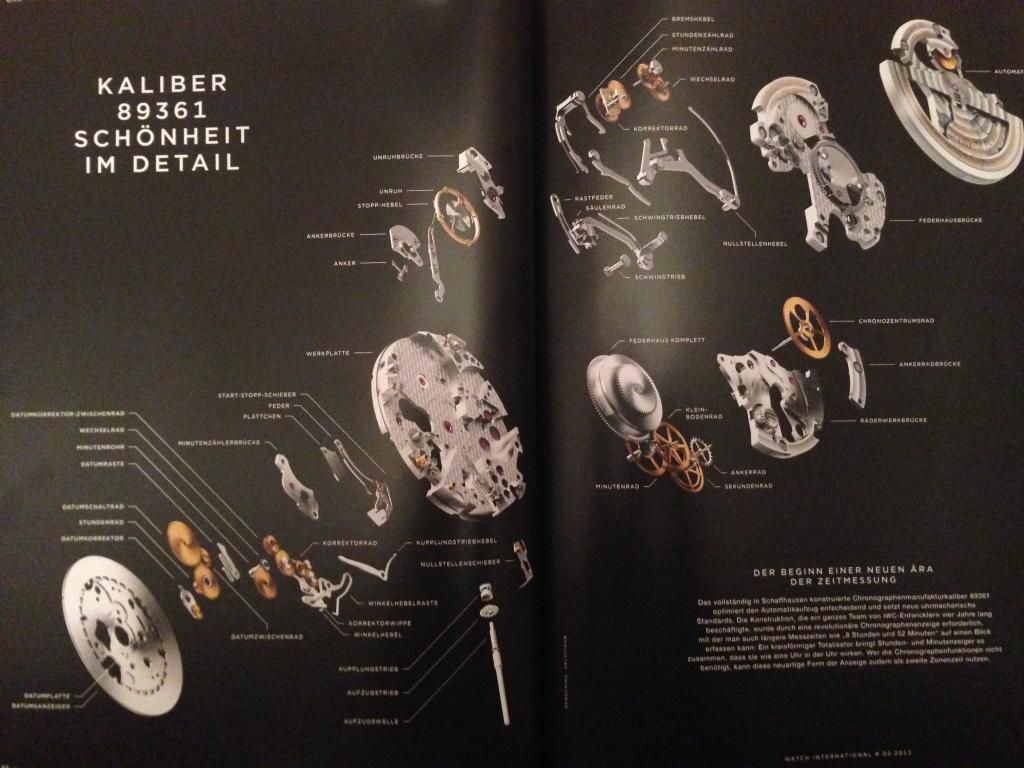
    Here is a detailed view on Cal 89361 - it was in one of the last IWC watch magazines …

    i42.photobucket.com/albums/e312/uhrvoll/4C588F05-A41A-4C83-B117-7019DFED888C_zpsaxtpxdrf.jpg

    Best,
    -Christian

  • Graduate
    25 Sep 2014, 9:24 p.m.

    why have they left the 89365 to look unfinished in the looks dept no machining or even golden lettering etc?

  • Connoisseur
    10 Dec 2016, 7:01 p.m.

    Red pen. (Costs less.)