• Connoisseur
    12 Jul 2009, 11:05 p.m.

    When I showed three of my recent pocket watches, for which their special virtue was their cases, one member here asked me to show their movements. Rather than simply do that, I thought I’d show the movements in a broader context –a brief history of early IWC pocket watch movements.

    For brevity, I’ve excluded the earliest movements –the Jones, Seelands, etc. I’ve also excluded later movements, from about 1930 on, including the well-known calibre 98 and its thinner sister, calibre 95. I also can’t cover all movements or technical details in this one post.

    [www.iwcforum.com/Movements/PW-Movements1.jpg](www.iwcforum.com/)

    The first movement here, on the left, is an early one, number 5025 in the “second numbering” and is, I believe, an Elgin I (I need to obtain further information on it –it could be a slightly earlier Pfister). You can compare it to the Pallweber –the “jump hour digital” which is an Elgin II. Finally, you can compare them to a “Calibre IWC” –an early Calibre 52.

    The Calibre 52 had many variations –different balance cocks, different regulators, etc. It was the ‘workhorse” IWC pocket watch movement, and was made from 1888 to 1940, in almost 300,000 examples –and over 460,000 if one counts its sister Calibre 53 savonette movement. Shown here is another Calibre 52, and compared to a late example Calibre 57:

    [www.iwcforum.com/Movements/PW-Movements2.jpg](www.iwcforum.com/)
    I always considered the Calibre 57 as a less expensive variation of the Calibre 52, but you can see here that the Calibre 57 certainly holds it own to this one Calibre 52, especially on the regulator.

    Also, during this era --the first few decades of the 1900s-- IWC also produced “finger bridge” movements. You can tell them from the long narrow cocks. The first was the Calibre 65, which is here is shown as a late example. The second was the Calibre 73, an almost identical design with an especially thin movement (its Savonette sister, Calibre 74 also was used in early Portuguese wristwatches).

    [www.iwcforum.com/Movements/PW-Movements3.jpg](www.iwcforum.com/)

    Finally, at the far right is another finger bridge movement –the Calibre 77, which also came in several finishing variations, and even different jewelings. Some collectors consider the Calibre 77 as IWC’s most beautiful movement. There’s even one who calls himself “watch77”.

    Hopefully this brief introduction helps you visualize IWC’s early movements. Compared to today’s finishing standards –with anglage on the edges of the plates, stripes and perlage, most of the older movements (with calibre 77 as a notable exception) weren’t as decorated. They’re still perfectly functional, after all these years, and I still consider them beautiful.

    Regards,
    Michael Friedberg
    [www.iwcforum.com/Articles/MFPocketWatches/PocketWatchGIF.gif.gif](www.iwcforum.com/)

  • Master
    13 Jul 2009, 12:05 a.m.

    Thanks for the inside look...

    I can't help but see the basic similarity in all these movements. We noticed the same thing about all the PW's we saw at the Watch Museum in Pennsylvania.

    I am amazed at the great condition of each watch.

  • Master
    12 Jul 2009, 11:10 a.m.

    Tons of effort in collecting the pocket watches

    before these photos can be made happened. thanks MF!

  • Master
    12 Jul 2009, 5 p.m.

    Thanks for the interesting...

    and educational post! I really enjoy getting to look at the "mechanics" of these fine watches... and your excellent commentary!

    Best regards,
    Jim

  • Master
    13 Jul 2009, 7:50 p.m.

    Thank you Michael...Just great!

    Cheers from Isobars.

  • Master
    13 Jul 2009, 2:30 p.m.

    the cal 73 is beautiful...

    i've been trying to get one for a year now with no luck.

  • Master
    13 Jul 2009, 9:30 a.m.

    Definitively a post to remember, save and

    keep as a precious gift. Calibre 77 left me breathless, I'm trying to recover right now.

    Thank you very much Michael. Do you think a cal 77 would be still available somewhere, I mean, how hard it's hard to find? Sorry if this may sound amateurish but, to tell the truth, I'm completely ignorant about this world.

    Please tell me if you find more appropriate to write you by private mail, I thought posting my question could be useful for other members.

    Thank you in advance.

    Regards,

    Roberto

  • Connoisseur
    13 Jul 2009, 7:25 p.m.

    Finding calibre 77's....

    Hi Roberto,

    Most of the calibre 77s were made, apparently, for the US market. That means several things:

    1. You most likely won't find one in Italy, or even Switzerland, but rather the US. That in turn means you'll probably need to look at international auction sites as a source.

    2. Most have CressArrow cases, since the US marketed watches then were cased in the US (more on this in the archives)

    3. Many have dials just saying "International", in print, rather than the typical signature --again, because the watches were US-assembled.

    However, the movement I showed you here is one of my two calibre 77s (more again in the archives) and this one has a Probus Scafusia case --that is, the watch was produced totally in Schaffhausen. That is quite rare: I've heard that a few hundred of the calibre 77 watches were produced that way (mine, more interesting at least to me, was sold initially in Uruguay).

    I don't have my reference sources as I write, but if I recall under 20,000 cal. 77s were made. They are less common but not impossible to find --and most of the sellers have no idea iof their rarity or special character.

    In fact, if I recall it's the only pocket watch calibre of the era with 21 jewels (there's records of 23 or 25 jewel ones, too, but I'm not sure the latter really exists). Still, those high jewelings show that IWC was trying to produce something special. The cases also are often special, with fine engravings and frequently enamel details.

    Regards,
    Michael

  • Connoisseur
    14 Jul 2009, 3:15 a.m.

    Thank you Michael...

    Your PW is still amazing me, as your knowledge about them.

    When I compare the IWC movements to my 1927 Elgin PW, I see less finishing in IWC, curiously, as the quality of IWC movements is much more higher.

    Regards,
    Jean

  • Master
    13 Jul 2009, 7:45 p.m.

    "Eight is Not Enough" as we see here>>>

    For the younger or non American Forum members, Eight is Enough is a 1970" TV show. MF's posts shows that eight is not enough and I would like to see more of his incredible PW and wrist watch collection. It is great to get the history and tradition lessons that come with each showing of his babies.

    Bill

  • Master
    14 Jul 2009, 6:40 p.m.

    Interesting selection, Michael - and a question

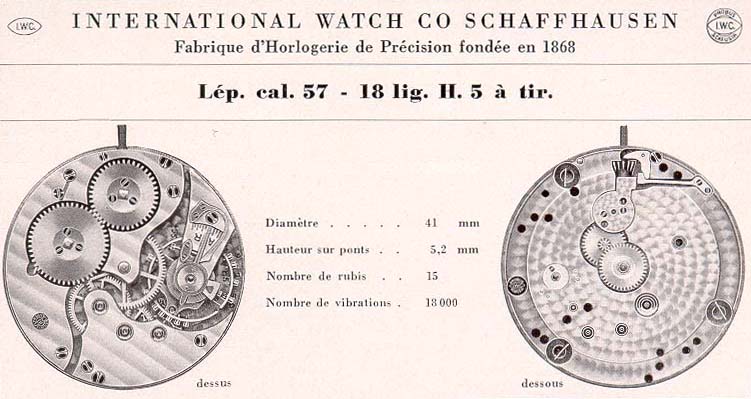
    On the calibres 52 and 57 - to me your cal 57 looks like a cal 52, judging by the fournitures I've borrowed from Greg Steer's site, which I hope he won't mind for educational purposes.

    I had always thought one of the main differences between the calibres 52 and 57 was that cal 52 had a three quarter plate and the escape wheel on a cock, whereas cal 57 had it on a bridge, with the smaller plate.

    Interesting, hence allow me to ask whether you are sure the 1916 movement is a calibre 57? I can't make out the movement number to check with Marco Schoeneberger's Date Your IWC programme.

    Thanks for showing us, Dirk

    www.gregsteer.net/IWC/Fournitures_7/Cal52and53_18and19ligH5Tirette.jpg

    www.gregsteer.net/IWC/Fournitures_7/Cal57Lep18ligH5.jpg

  • Connoisseur
    14 Jul 2009, 7:55 p.m.

    good question...

    I had checked the serial number of the (purported) c. 57 in the Meis book, if I recall, but I could have checked incorrectly or there could have been an error, either in the book or as the watch was stamped. I will check again, but it may not be for several days due to where I will be relative to where the watch is.

  • Connoisseur
    20 Jul 2009, 4:30 a.m.

    ..and after checking you are right...

    Hi Dirk,

    Of course when I saw your image if the two movements I realized that I certainly had a c. 52 three quarter plate.

    The problem was hurrying and misreading a not-well stamped serial number. I read 653xxx (which translates to a c. 57 from 1916) and in fact it was 658xxx (which translates to a c. 52 from 1917). I should have caught that.

    Thanks,
    Michaek

  • Master
    21 Jul 2009, 6:15 a.m.

    Thanks for following up, Michael (nt)