Here a photo of a real nickeled c. 34 (n. 616) probably for the South American market.
Take from internet:
www.faszination-uhrwerk.de/w/w19/a19/ankerwerke-19.html
Elgin I. 314 (c.32)
- 27 replies
- last reply by urig 22 Apr 2012
-
 Connoisseur
 -
 Master
faszination-uhrwerk.de is an interesting homepage and made by an expert in IWC-Watches.
The only thing I do not appreciate is the wrong indication of the source of the pictures on this site. Many pictures where copied from other sites, but below the pictures you can read "faszination-uhrwerk".
The picture you copies, came once from the homepage "Zeitwerke.de" of F.Wagener which was also a well known participiant of this forum.
There are also some pictures copied from "vintage-iwc.ch", a page witch is no longer maintained. -
Connoisseur
I understand and agree. Obviously I'm interested in the movement that is relevant to the discussion.
-
Connoisseur
Sorry Hans but I don't understand. In my opinion the movement is not an Elgin III and is not a Seeland Calibre.
Regards
Giovanni -
Master
Dear Hans
The picture you get for Elgin III with hidden winding section (c.47) is the picture below.
As I explained the "created" c.34 picture above, is a photoshop work =FAKE), combining a picture of the c.32 at the bottom and the picture below, just to demonstrate how a c.34 should look like, before whe had the watch of "Zeitwerke"
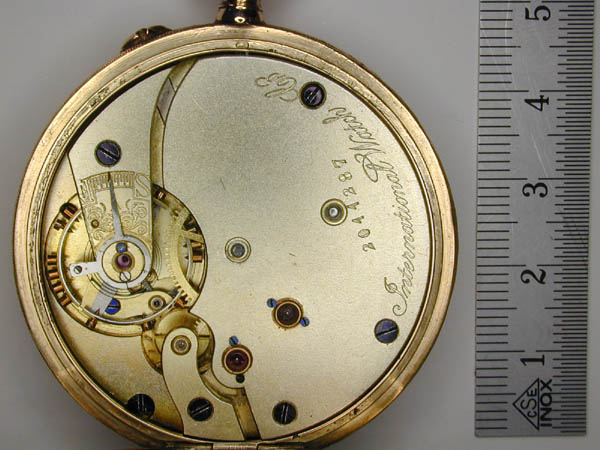
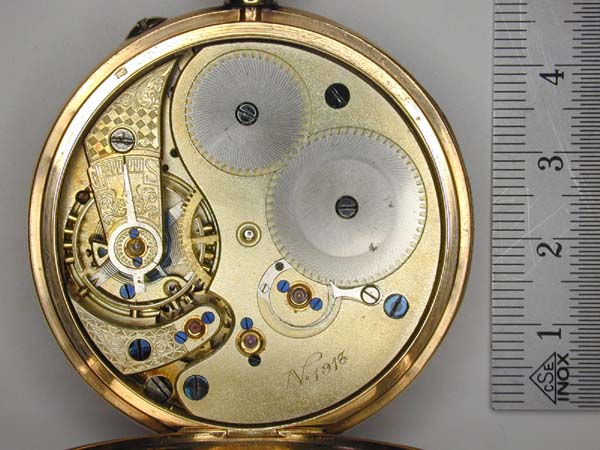
-
Connoisseur
Ok Ralph, now it is really an Elgin III!
Can you explain why in all cal. 47 I know the number 20 is placed before the real number of movement that in this case is 11287 (second numbering system)? -
Connoisseur
I believe that it has a relationship with the numbering system introduced by Seeland.
Even calibres 28 and 29 have similar characteristics with a numbering preceded respectively by 10 and 11.
But I do not understand why only traces of the system remained in Cal. 47, in movements which belong to the second numbering system. -
Graduate
Since I have had two pieces of C33 movements only without cases (unfortunately they have lost their cases because of the gold content)one of them has been recased as a wrist watch making it suit for daily use.
Regards
Á -
Master
I think the "hidden winding wheel" system "à Bascule" which is a system like a balance under the plate (see picture), was introduced by LeCoultre as a very early system to swich between winding and time setting.
I think it is compared to the "ordinary" winding more complicated but is has hidden winding wheels (under the dial). Watches with invisible winding wheels where produced for a special market, probably south america.
So during a quite long period some few watches where build with the standardconfiguration of the running wheels and bridges, but with the special winding section.
The picture shows the system in the winding position, when the manual lever is at the arrow position, it is in the time setting position. With this system, it was possible to set a hunter mouvement automatically to the winding position, when the cover was closed.
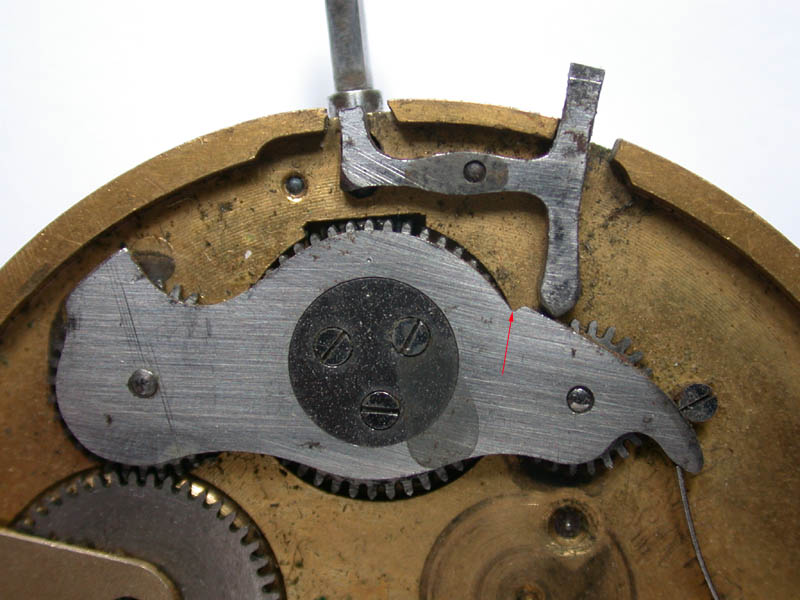
-
Insider
Hi Giovani!
Of course you are right. I was a bit confused with the new (2nd or 3rd) numbering.
The watches wih 7 numbers are the ElginIII types (c.47). It is hard to explain that the 7-number system remained after starting he new numbering. Fortunatly Ralph Ehrisman had an explanation for this phenomen!
Best regards!
Hans