• Connoisseur
    5 Jan 2011, 4:48 a.m.

    www.iwcforum.com/website/Cal22-24-26-28.jpg

    I realize that this is historical esoterica, but my research here took some unusual turns.

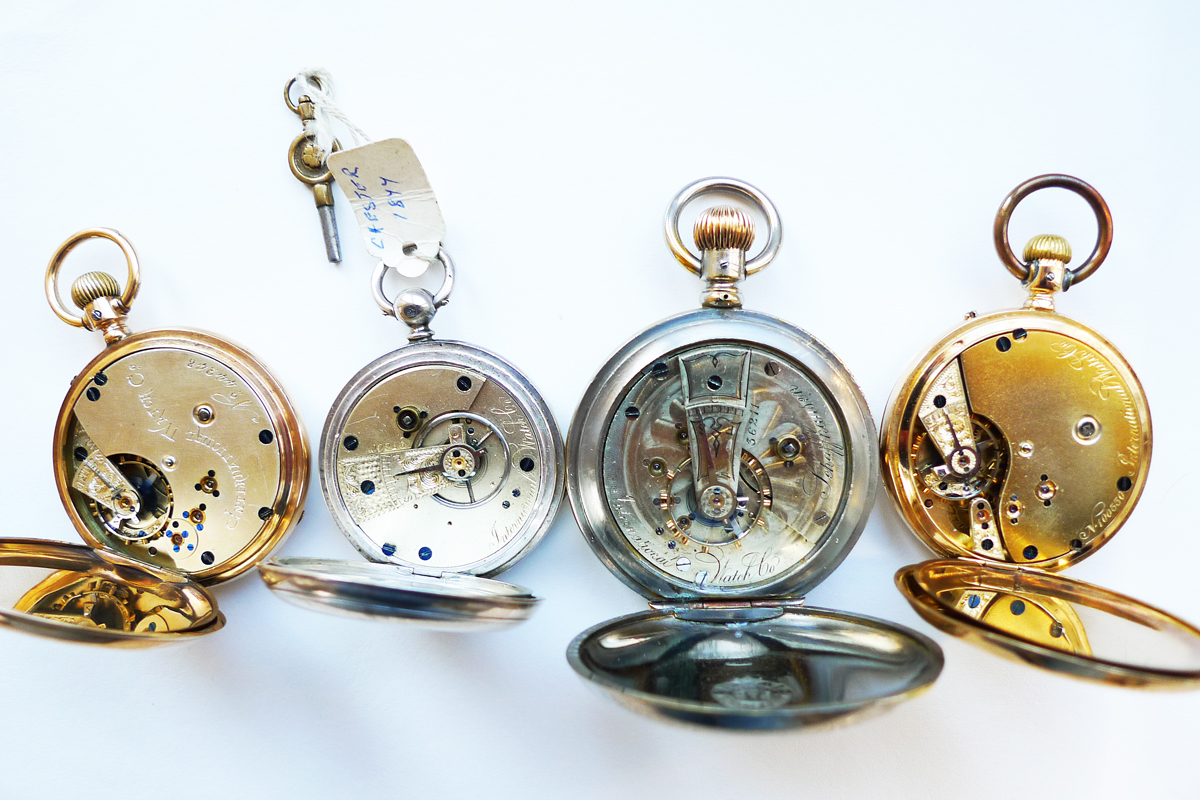
    Shown above are four very early and rare IWC pocket watches, the Calibres 22, 24, 26 and 28. They most likely are from the period 1877 to 1882, a somewhat turbulent and certainly transitional period in IWC’s history, right after Jones.

    The Calibre 22 “Seeland” was recently acquired, but it certainly doesn’t look like the “typical” Seeland (calibre 24, and also 26). Rather, it looks like an earlier Calibre 28, on the right. So I checked, and found an old e-mail from the late Fritz Wagener (“early iwc”) to me. He wrote me:

    “According to expert's comprehension, (incl. Jürgen King) during the era F. Seeland there have been developed/built only the caliber "Boston" namely the c.24 –c.26. The caliber c.18 – c.23 are ascribed to the following period of Tschopp/Pfister”.

    As usual, I think he may be right. if so, the early movements weren't always numbered in historical sequence.

    By the way, by right clicking you can see a much larger view of the image.

  • Connoisseur
    5 Jan 2011, 5:42 a.m.

    Hi Michael!

    I agree with you, cal.22 looks more "modern" and seems to be better finished too than cal. 24 and 26. Moreover, it doesn't seems to have the winding key, or maybe I'm wrong. So it should be more recent.

    Btw, great acquisition and happy new year!

    Jean

  • Connoisseur
    7 Jan 2011, 6:16 a.m.

    More here, even if the subject is of limted interest.

    I just heard from one researcher who said "we discovered in the archives, beautiful coloured drawings of the three-quarter plate calibres 18 and 21 which bore an IWC stamp for 1878, so they must have been designed by Seeland. Another fact is that at least one of these three-quarter plate movements was actually in production by the middle of 1878 because ebauches are listed in the Inventory of July 1878.
    So what we know is that these three-quarter-plate designs were made at some time before the summer of 1878 and so could not have been made by Pfister ".

    Perhaps my Calibre 22 is a Seeland after all.

  • Apprentice
    10 Jan 2011, 10:55 p.m.

    Dear Michael,

    First of all I like to wish all IWC forum members a happy new year 2011.

    You are quite right, Michael; we are studying the sources of Seeland era and the development of the Seeland calibres.
    So far it´s getting clear that Seeland did more than designing and producing only fullplate movements. Seeland has got a clear business plan and sales strategy.
    For example Seeland wanted to design different movements for specific markets.
    There were movements in an “English style” (fullplates) and the “German style” (three-quarter plate calibres) as Johannes Rauschenbach told 1880 when he was talking about product strategy of former IWC CEO Fred Seeland.

    The so called “Pfister” three-quarter plate calibres movements were made by Fred Seeland to substitute “old” three-quarter plate Jones movements. Although the production of the Jones movements was kept up till the mid 1880ies!

    As far as we know investigating sources at IWC corporate archives R&D of the three-quarter-plate models of Seeland took place in 1877; the first prototypes were made in June/July 1878. Probably the manufacturing of the three-quarter-plate started in autumn 1878.

    I know that all of you are very curious to know what exactly has happened from late 1876 till mid 1879 when Fred Seeland was IWC CEO. But our “research circle” (all that collectors involved in this project and myself) want to communicate all our research when all the evidences will be proved as best as possible. So please have a little patience. I think when we will have checked all existing sources there will be a “new” history of the early IWC movements.

    So your statement Michael is not “historical esoterica”, it is an important scientific question concerning early IWC business and product history. It´s one of those questions we are still looking for answers.

    Thinking of the research done till now I´m quite sure, that your Calibre 22 is a Seeland.

    Best wishes,

    David Seyffer
    IWC Museum Curator

  • Master
    11 Jan 2011, 12:09 a.m.

    The ability to get a direct response to a forum question from the curator of the IWC museum is what makes this forum the definitive IWC Forum. This is interesting historical research to which I look forward to updates.

  • Connoisseur
    11 Jan 2011, 1:30 a.m.

    Thank you, David, for your information.

    I look forward to better communication and perhaps coordination between the Museum and its appointed "research circle", on the one hand, to this forum and the collectors here on the other. It's nice to hear from you, and thank you for your post!

  • Master
    11 Jan 2011, 3:37 a.m.

    This tread is a manifestation of why the Collector's Forum is such a special place with special contributors and a superb moderator.