• Apprentice
    19 Dec 2025, 3:14 p.m.

    Dear all,

    A new member here, and a relative novice in things technical and historical IWC.

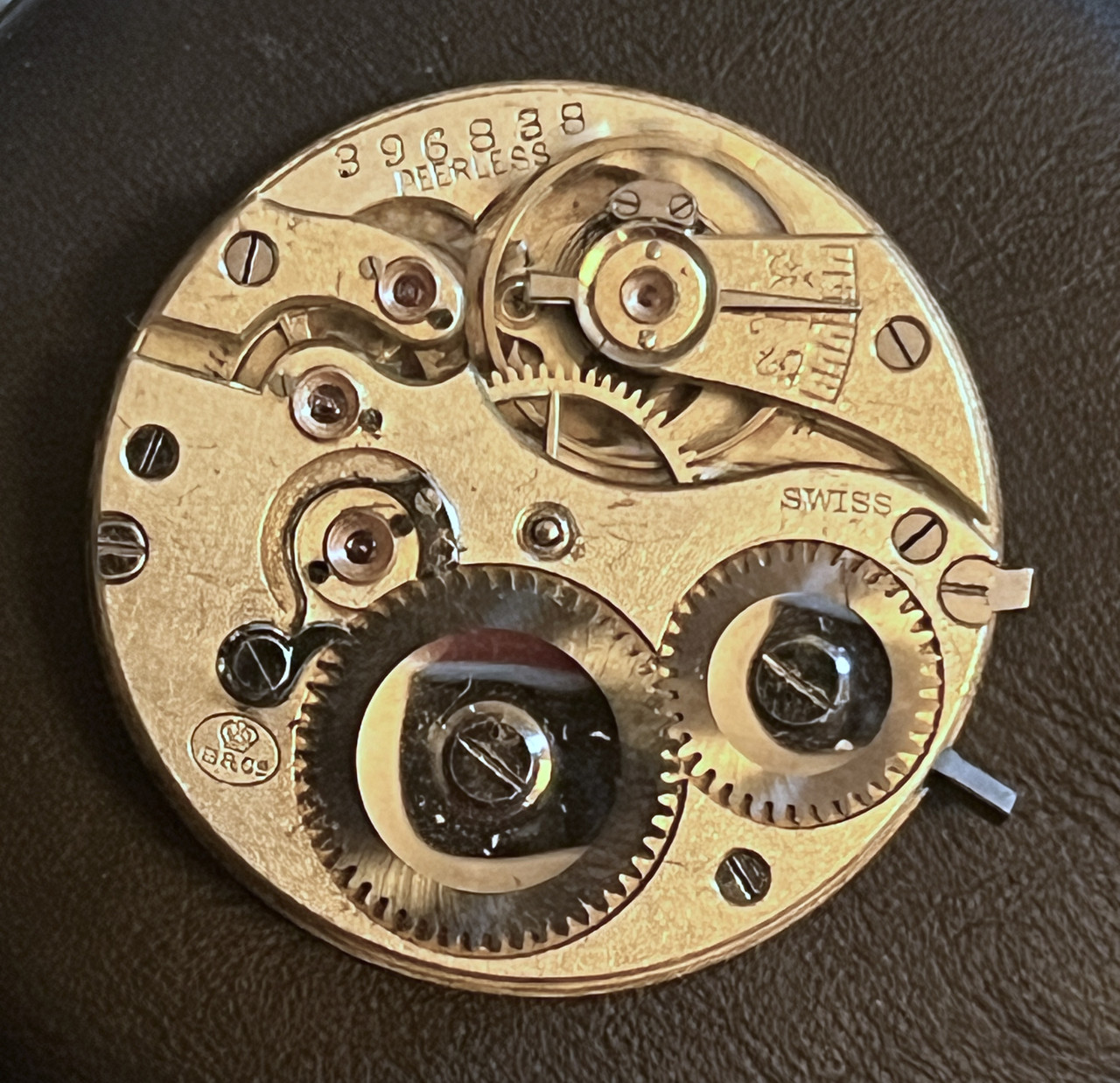
    I recently purchased this loose Stauffer/peerless/IWC mvt as a potential parts donor for a 1916 Stauffer/peerless cal 64 Borgel wristwatch that I have, just in case needed in the future, and as it was running I felt it was crazy not to purchase it at the price.

    Anyway, I put the serial number 396838 in the 'Date your IWC' app and it came up with a cal 63, lepine, 1907.

    I would assume from a ladies fob watch, it winds at 12, sub seconds at 6, that has had the gold case scrapped.  The balance and escapement cocks are of a very slightly different tone to the other bridges so could have been swapped.

    Obviously, the chances of sourcing a replacement case are extremely slight, which is a shame, really.

    What I am curious about is it has a slide set for setting the time, not a pin set.  I thought that this was a time setting mechanism belonging to hunter type cases, not open face cases which I understand was the typical case used to house the cal 63.  After initial googling around I have struggled to find another slide set cal 63, or am I missing something?


    Edit: I tried to upload a couple of images but got the "unknown error occurred", apologies for that I wil try and sort it out.

    I still seem to get the error message posting pics, even singly, the largest is only 1.6mb, they are jpg.  Any help with that would be appreciated.

    This is the only way I could find to get the images here, if you copy and paste the link it takes you to the image.  Apologies again for this hassle.

    https://i.postimg.cc/D0TNv0xH/iwc-cal-63-mvt.jpg

    https://postimg.cc/75jr2WzP


  • Apprentice
    23 Dec 2025, 11:59 a.m.

    Having googled extensively now and still not found a hunter cased slide set cal 63, I am going to presume that there is a minor blip in the info provided in 'Date your IWC' app and the movement is a cal 64, not a 63.

  • Connoisseur
    23 Dec 2025, 4:13 p.m.

    As your movement winds at 12 and has subseconds at 6 it is a Cal. 63, no 64.

    There have been few Cal. 63 with hand setting a targette when it came to the question how to make use of ladies pocket watch movements for wristwatches. They returned by the end of WW I.

    I have one of those and saw several in the field. 

    They normally sit in a gold case.


    Regards

    Th. Koenig

  • Apprentice
    24 Dec 2025, 9:45 a.m.

    Hi Mr Koenig and thank you for your reply.  Can I presume then that your watch is in a hunter case?

    I will keep my eye out, probably forlornly, for a silver hunter case of the appropriate size.

    Best

    Mark

  • Apprentice
    25 Dec 2025, 7:23 a.m.

    Welcome. What you’re seeing is normal.

    Early cal. 63 movements were produced with both pin-set and slide-set mechanisms. Slide-set is not exclusive to hunter cases—IWC (and Stauffer) used slide-set on some open-face and ladies’ fob watch versions as well, depending on the case maker and market.

    Key points:

    • Serial 396838 (~1907) fits cal. 63 production.
    • Winding at 12 / seconds at 6 is correct for open-face.
    • Slide-set was often specified by Borgel or retailer orders, not strictly by case style.
    • Slight color mismatch on cocks is common and doesn’t necessarily mean incorrect parts.

    So you’re not missing anything—your movement configuration is plausible and period-correct, just a less common variant.

  • Apprentice
    28 Dec 2025, 1:03 p.m.

    Hi Mark,  thank you very much for your full and in depth reply.  That is very helpful and definitive.  It would be wonderful to stumble across a Borgel case to re-house it but I rather suspect it will remain a 'parts watch' for my cal 64 borgel, as originally purchased.

    Thanks again.

    Mark

  • Apprentice
    31 Dec 2025, 7:16 a.m.

    While the cal. 63 is most commonly seen as a pendant set Lepine movement, slide set examples do exist. IWC supplied the same base caliber with different setting mechanisms depending on the Capstone Phoenix intended case and customer requirements, especially for Stauffer/Peerless deliveries. Slide setting is more typical of hunter cases, but it was not exclusive to them, and transitional or special order configurations do turn up from time to time.

    The tone difference on the balance and escape cock is also not unusual and does not automatically indicate a later swap. Finish variations within a production batch or during servicing were common in that era.

    In short, a slide set cal. 63 from around 1907 is plausible, just uncommon. Finding a correct case will indeed be difficult, but as a running donor or study piece, it’s a nice movement to have.