• Connoisseur
    9 Nov 2012, 2:39 p.m.

    i1139.photobucket.com/albums/n558/michaelfriedberg/44b69fbb927253669feef3fe04639da0.jpg
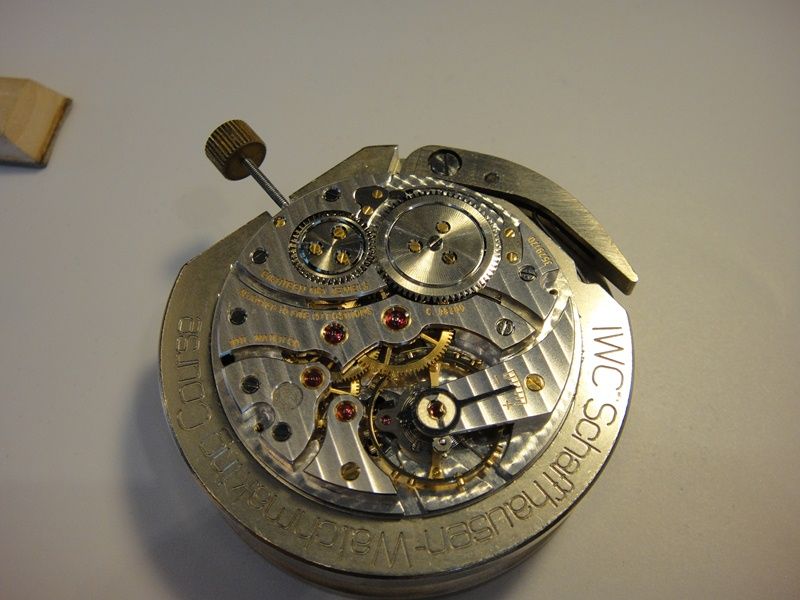
    This movement is now used in watchmaking classes, as photographed and reported by one forum member who recently attended a class. You can read Sidestreaker's excellent report from Abu Dhabi at www.iwc.com/forum/en/discussion/59338/?page=1

    But --what is the movement? Can anyone tell me which IWC model (reference) has the exact movement inside of it? It's not the same as a calibre 98 or 982 or 9821 (for example the regulator, the finishing and even the number). I haven't checked, but I don't believe it's in any movement lists published by IWC (although it's made by IWC and I'll bet in internal lists).

    So --what is this movement?

  • Master
    9 Nov 2012, 4:06 p.m.

    A 16 3/4 ligne PW movement. Small seconds only as per ref 5434. Whether the movement is the modern numbering of a four digit calibre series. Might this be the surplus from movements for PW that were never cased due to lack of demand for PW?

  • Master
    9 Nov 2012, 5:09 p.m.

    Bossman, you got me stumped!

    Roberto?

  • Master
    9 Nov 2012, 6:51 p.m.

    Here I am my friend but without the answer!

    Unfortunately, I have no clue :(

    For what I see the center wheel bridge has been cut off in some parts to give room to the ratchet and crown wheel, I wonder how thick this movement is.

    The shape of the balance bridge really reminds me of something but I couldn't say what it is.

    Regarding the reference, I really don't know where to start, but it's fun!

  • Connoisseur
    9 Nov 2012, 8:04 p.m.

    OK --some more. This is "technically" a new movement, used ONLY in IWC's watchmaking promotional classes!

    The problem is that weren't enough of the "old" pocket watch movements laying around. Calibre 95x's were first used, then Calibre 98x's. But IWC didn't have an unlimited supply of these and, as you might imagine there's some wear and tear when mangled by "amateur" watchmakers.

    Now --IWC did have its Jones movements, a version of the Calibre 98. But those movements were redesigned Cal. 982's that had a three-quarter plate and a special regulator (the Jones arrow). The plate hid the movement and the regulator required more disassembly.

    So --IWC redesigned the Jones movement to have separate, and easily accessible bridges. And note the simple regulator --there's not even a Swan's Neck spring to hold it in place.

    Bottom line: this is a movement in current "production" but not used in any specific IWC reference. I think that might be a first for IWC. It is truly a "school movement".

  • Master
    9 Nov 2012, 8:12 p.m.

    This post is hidden. You cannot not see its contents.

    Hidden by on 8 Nov 2018, 4:36 p.m..

  • Master
    9 Nov 2012, 8:58 p.m.

    Michael, thanks for sharing this info.

    The movement to me looks so "IWC" - all the right lines so to speak!

    Now I need to sign-up for yet another masterclass - so I can get a closer look at those bridges.

  • Master
    9 Nov 2012, 9:21 p.m.

    Thanks for the explanation Michael.

    Imagine if this is to be made commercially available. It is after all a gorgeous looking movement and provide much visual interest. I'd probably choose this over the current Cal.98XXX!

  • Connoisseur
    9 Nov 2012, 11:13 p.m.

    Vincent --agreed. The one deficit is that the regulator is a bit primitive, but it's still a classic movement. We talked, mostly in jest, that it would be a very cool movement for a collectors' forum watch, but it's not realistic to produce some for such a project.

  • Master
    10 Nov 2012, 3:53 a.m.

    a 'new' movement ! great to know. thanks for sharing Michael.

  • Master
    10 Nov 2012, 9:40 a.m.

    It looks like bridges are kept together, probably to facilitate assembling/disassembling process?

    i294.photobucket.com/albums/mm101/flyrobyfly/Current/44b69fbb927253669feef3fe04639da0.jpg

  • Master
    10 Nov 2012, 7:01 p.m.

    I'm toying with the idea that when all these calibre has run its course, perhaps the organizers may consider 'contributing' some of these pieces to few lucky collectors. It proudly bears the scars caused by countless novice watchmaker wannabe (some of which I have contributed personally)

  • Master
    10 Nov 2012, 7:29 p.m.

    The 4th bridge and the train bridge are kept apart.

    Here's another picture where the 4th wheel bridge is still intact while the train bridge has been removed along with the 3rd and centre wheel.

    i691.photobucket.com/albums/vv272/sidestreaker/Timepiece/Step06.jpg

    I may be wrong but I think it would be more difficult to reassemble it back if they were together as we were already struggling to make sure the 3rd wheel and the main wheel's pinions and positions were precise to avoid any of the pinions breaking off when securing the bridges down. It would be more challenging if we had to deal with the 4th wheel in the same time.

    After the class I have a better respect and understanding for some watches with one piece large barrel plate. Though they may look less attractive compared to separate plates which expose more movement below, I think it would be more difficult and requires more dexterity to align all the pinions to the jewelled position and securing the bridges.

  • Master
    10 Nov 2012, 10:19 p.m.

    Wow, that's very interesting. Thank you very much for these details and for the pictures too!

    Kind regards,

    Clemens

  • Master
    14 Nov 2012, 8:51 p.m.

    It seems IWC starts to build again watches for me:
    POCKET WATCHES C.98xxx
    :-)

    Can I get that one in a hunter case PW too?

    best regards

    RALPH

  • Master
    14 Nov 2012, 8:52 p.m.

    Dear Michael

    Could you send me the application form to participate such a "Watch making course". I'd fill it out immediately. ;-)

    Best regards

    Ralph