Prologue:
In every watch collector 's life comes a time when s/he identifies a grail.
Sometimes this grail is either no longer available or is in extremely short
supply. In my case, the IWC 3799 Doppel Chronograph Edition "Top Gun" is my
grail watch. When I set eyes on it some seven years ago, the quest to own it
was ignited.
So, why did I hunger for a 3799? I had always wanted a highly anti-magnetic
watch that had some haute horology complication (like a rattrapante) and
serious aviation lineage (I am a sucker for pilot's watches, if you haven't
already guessed as much!). A few years back I had the opportunity to order for
a 3713, but the piece had some defects so I had to woefully return it to the
AD for a full refund. When IWC launched the 3799, around 2007 it was all that
I wanted and yet some - stealthy ceramic case, and those lusty hands. I had to
have one! But it was a rare watch - Not only was it a limited production
piece, IWC had pulled the plug on it in 2012. Unfortunately, our minds work in
weird ways, and the thirst to own this extremely rare piece remained
unquenched.
Then one day I casually sauntered into another AD that had only recently
started to stock IWCs, and my eyes fell on a 3799 in the flesh! With my
finances (and my fiance) permitting, I was just about to pull the trigger when
some pictures of a broken ceramic cases caught my attention. Finally after
going through multiple forums and interacting with the friendly forummers, my
fears were laid to rest - an incident that would break ceramic would
irreversibly dent a metallic case as well. So I went back to the AD, agreed on
a good price and bought it. The watch had been with them for more than a year
- it was as if it was destined to be mine!
Initially I found very few reviews of this watch and thought I would share my
experience with others. Though the 3799 is no longer available, I hope readers
may get some information on the common themes (such as the ceramic case, anti-
magnetic features et cetera) that tie this unique reference to IWC's current
pilot's lineup. In order to keep it simple and interesting, I have divided
this review into 4 parts that capture the various dimensions. This factual
review is based on whatever research I was able to do on the watch. I will
really appreciate any inputs from knowledgeable readers to correct any
deviations they notice. I am not a professional photographer, so please bear
with the quality of pictures!
Now lets "fly" straight into the review!
Case:
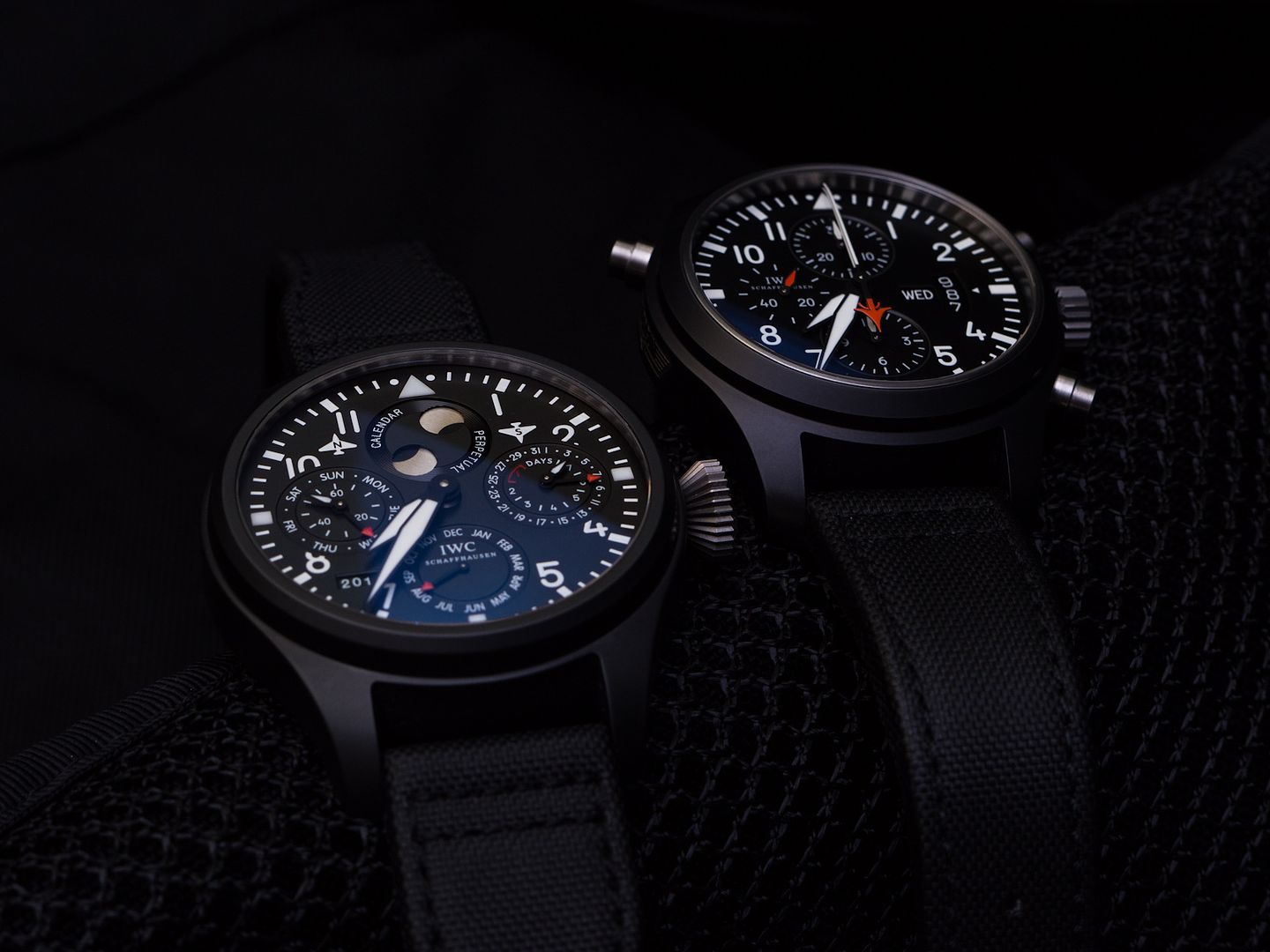
The 3799 has a classic styled 46 mm case that is typical of the IWC pilots
line, with an inter-horn length of 22 mm. The material used for the case is
the highlight. IWC used Yttrium stabilized Zirconia (YSZ) for the case and
uses an injection molding process to create a case block which is then baked.
The ceramic case block actually shrinks in the oven. Once this process is
complete, diamond tools are used to sculpt it to the final shape. This is then
attached to a titanium case ring, on the inside, using adhesives ensuring that
case is water resistant to 6 bars.
The material itself is extremely hard and is rated at around 1400 Vickers in
hardness. Not only is the material light and skin friendly, it has a
comfortably warm feel when you touch it. Like its newer IWC ceramic siblings
currently available, the crown, pushers (all three of them) and the case back
are made from Grade 2 Titanium. Unlike the button guards and the sides, the
tips of the buttons themselves are polished. The tip of the crown is polished
as well. The crown has the "Probus Scafusia" tastefully embossed onto it.
These polished areas worried me because of the softness of Grade 2 Titanium of
around ~180 Vickers. But IWC being the pioneer in the use of Titanium, have
done something that makes them more scratch resistant. The case back has the
"Top Gun" logo reverse printed under a sapphire crystal. All these together
make the watch feel much lighter than what you expect given its size.


The entire case has a matte finish that gives it an absolutely stealthy and
understated look. It looks like a quintessential aviation tool and you feel
like putting it through the paces. I have been continuously wearing it for the
last couple of weeks and have had it on my wrist in situations where I have
been working with an impact drill, cleaning my roof..and so on! Only
yesterday, I bumped it once on the wall, and that gave me a minor heart
attack. So I decided to inspect it using a 5X loupe under a spot light - the
material is absolutely amazing! Not a single scratch or blemish on it after
weeks of such harsh use. I have read many an instance, where other owners have
seen a scratch on the ceramic after bumping into something, only to realize
that it is material deposited from the object the watch bumped into. I hope
that glory lasts my lifetime at least!
Though I have not opened the watch, there is a "soft iron" inner movement ring
and an inner case back that, together with the dial completes the inner case.
This shields the movement from detrimental effects of a stray magnetic fields
to at least 24,000 A/m (300 Gauss), or more.
The native strap that comes with the 3799 is made of Kevlar, with a leather
lining. The tang type buckle is made of stainless steel which has been bead
blasted to look like titanium. I was initially vexed on this point when I
bought the watch, and I though there had been some mistake in my case. But
further correspondence with IWC and subsequent research on forums revealed
that the tang type buckle is indeed steel, as is the case with 2012 Pilot's
line-up as well. In 2013 however, the titanium Ingenieurs got titanium
buckles. It is difficult to work with titanium, and production costs for such
a small part were probably not justified - IWC being a pioneer in the use of
titanium, I trust their decision. This little detail however, does not bother
me as I have installed a NATO on it keeping in line with the overall theme of
the watch. Its only proper to use a MOD spec-ed G10 on an IWC with its RAF
Mark XI heritage!

Dial and Hands:
The dial design is absolutely functional given the theme of the watch. The
extremely legible layout only adds to the Spartan beauty. There is something
about the main hour and minute hand that is so good. IWC seems to have gotten
the proportion of the hands close to perfection. These two hands are filled
with Super Luminova (probably Strontium Aluminate). The black exterior of the
hands contrasted by the white of the lume is just perfect!
The dial is made of "soft iron", to complete the anti-magnetic inner case.
This is probably also the reason why the dial does not have any complex
designs (such as raised numerals) on it. The luminous elements seem to be
attached, rather than applied to the dial at the four points - 12 (the
triangle), 3, 6 and 9.
Together with these four points and the two main hour and minute hands are the
only luminous implementations on the watch dial - IWC stuck to their theme.
The white on the chronograph center seconds, rattrapante seconds and the two
sub-registers is just white paint - they are not luminous. The legibility is
absolutely superb at all angles even in low light.
I will spend some time on the two superimposed hands of the chronograph - the
center seconds hand at the bottom and the rattrapante hand on the top. This
sequence of superimposition is due to the fact that the rattrapante hand is
connected to a co-axial tube on the outside and the center seconds arbor is
inside this tube. IWC has done something really tasteful here and this was one
of those little things about the watch that attracted me to it. The
counterbalances of the rattrapante hand and the center seconds hand are
designed in such a manner that when they at 12 in reset, a superimposed motif
of a jet plane is visible - the wings forming a part of the counter-balance of
the rattrapante hand and the tail forming a part of the center second's
counterbalance. The magic happens when you activate the split mechanism and
these two hitherto superimposed counterbalance separate and "split" (pun
intended) the motif! I get ahead of myself - more on the movement later!
The running seconds register at 9 o'clock is also in bright red and together
with the red of the "Jet" motif of the center chronograph seconds and
rattrapante hands give a splash of bright red to the otherwise Spartan
business like presentation of the dial.


Another small detail worth a smile, is the way in which all of the hands -
main timekeeper's and the chronograph's - interact with the markers. As I have
already mentioned, these markers are white strokes. When the hands go over
them, they don't cover the markers entirely, instead falling short by a
fraction. So all you see is a small white dot of the marker and then the hand
below it. This really enhances the instant and accurate readability of
information - something critical to a pilot's watch!
The chronograph registers at 12 and 6 are slightly depressed into the dial and
have a very light circular design ingrained into them. This is visible only at
certain angles. Given the anti-magnetic capabilities of this watch, all the
hands, are also made of non-magnetic materials

Movement:
Aaah the jewel of the crown - Inside beats the IWC caliber 79230 29 jewel.
This engine is based on an extensively reworked chronometer grade Valjoux
7750. Earlier ETA used to supply IWC with unassembled 7750 kits that IWC used
to extensively work upon to improve an already proven workhorse. Since the
first decade of the millennium, ETA has stopped supplying movement kits such
as the 7750, they have been delivering completely assembled movements to non-
Swatch group companies. IWC states that ETA reworks the movements (2892, 7750
et cetera) according to IWC's own standards before delivery.
The rattrapante module was developed by Richard Habring when he worked for
IWC. Unlike most other 7750 based rattrapante movements, Habring's module is
attached to the bottom plate of the reworked 7750 rather than the top plate.
This is a more traditional approach. My research tells me that IWC has a
special department that (probably amongst other complications) deals with
assembly of this add-on.
If given the right training and a good environment to grow, does an adopted
child really underperform when compared to her sibling who is genetically
related to the parents? I think not! Even though the Valjoux 7750 base in
manufactured by ETA, IWC plays a major role in modifying it to its own
specifications. I do not know if the particular 79230 beating in my 3799 was
created from a 7750 kit or was it delivered fully assembled to IWC by ETA
based on the former's strict specification. It really does not make any
difference. The IWC magic is immediately obvious.
It's a known fact that 7750 and its multiple variants feel a bit stiff when
you manually rotate the crown to wind the mainspring. But the 79230 inside my
3799 feels silky smooth when winding - though, it could be in part because of
the large crown. Also, the typical 7750 rotor wobble is all but missing on
this caliber. Experts say that IWC does a lot of things to the 7750 (or ETA
does them according to IWC's specs…). As the individual components are
refined, their efficiency improves requiring a weaker mainspring to be
installed to reduce stress.
This caliber has been superseded by the 79420. There are no differences
between the 79230 and 79420 except the plating of the movement.
I have noticed an accuracy of half a second fast everyday on the wrist. I am
yet to gauge the accuracy across various positions though. Given the overall
robustness of the 7750 and IWC's modifications thereon, I would be very
surprised if this watch did not perform as accurately in the long run.
Wearing Experience:
One of the things I had against this watch (other than its extreme lack of
availability) was its size. On paper it looks huge. At 46 mm in diameter and
with a height of 17.8 mm, strapped to my diminutive 6.5 " Asian wrist, the
watch can be perceived to look like a clock! But in person it's a different
animal altogether. When I had the opportunity to handle this rare beast in
person and strap it to my wrist, the black case with the simple styled dial
makes the watch feel perfectly sized on my wrist. Though the watch is quite
tall at 17.8 mm high, it matches pretty well with the well proportioned 46 mm
case. Also, given the watch's lightness, you tend to overlook this height when
you consider whats under the hood - the additional height of rattrapante
module and the soft iron inner case. Since its black all over and devoid of
unnecessary bling, its size also goes into the "stealth" mode and wears
smaller than expected. All in all the watch feels perfectly proportioned on
the wrist. All in all the watch feels perfectly proportioned on the wrist. It
neither feels too tall nor too wide to wear. It's a tool, and it looks like
one!
Conclusions:
As I have already mentioned, this is my grail watch - its here to stay. As I
age and my eyesight deteriorates, the large ample dial and its white marking
are going to put a smile on my lips. I know may purists may feel that this
watch borrows on multiple aviator watches without being truthful to any one of
the lines - the hands inspired by the Beobachtungsuhr, and the dial from the
Mark XI. Nonetheless, somehow (at least to my happy eyes ;)) they got all the
good aviator designs in one place and created something so beautiful. It is
one hundred percent a pilot's tool watch that carves a niche of its own!
One thing I will admit - the watch was responsible for my spending hours on
the Microsoft flight simulator, with this baby timing all the flights!
I hope you have enjoyed this review! Do share your thoughts!


 ](
](