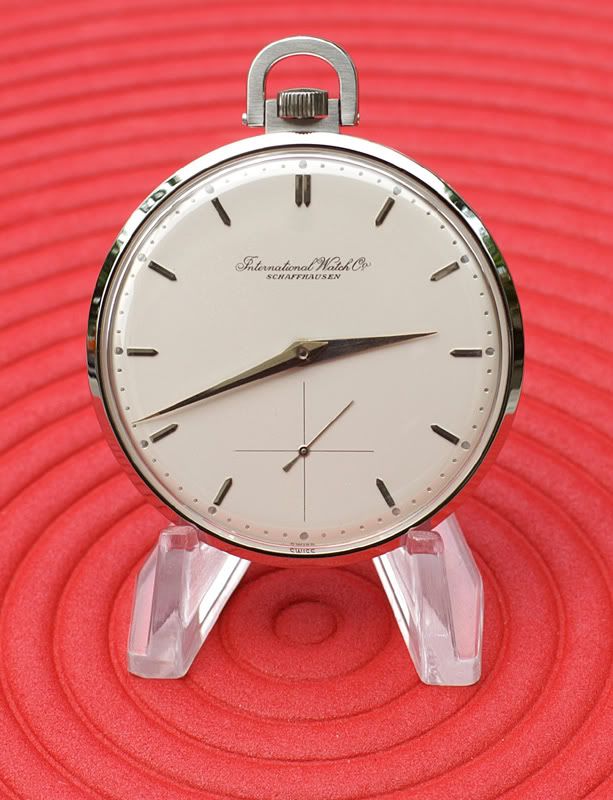
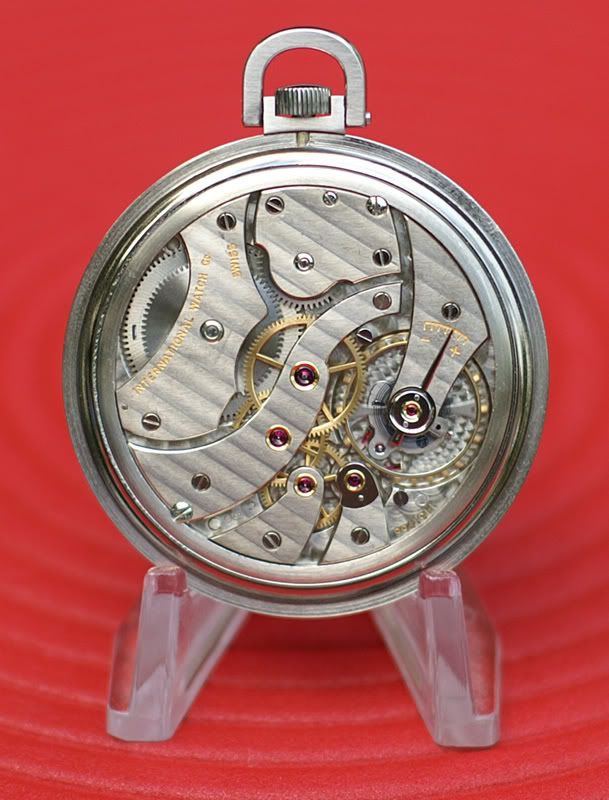
Maybe the hype around SIHH is more or less fainting away. After magnificent posts about the new Pilot's line, it is time to post again about vintage watches, the timepieces that made IWC as famous and respectful as it is today. Heiko Bertram already posted on a cal 66 pocket watch that he bought. There were serious doubts on its authenticity as the movement number and the case number were 40 years apart! The assumption was : this must be a "marriage": movement and case do not belong to each other. Than Heiko sent his watch to Schaffhausen. And this is what happened.....
Thanks Heiko and IWC for this educating information.
Kind regards,
H-G Aberle,
R. Birkenkämper,
T. Koenig
A. v d Meijden,
(alwaysiwc).
NOSTALGY FOR .........IWC POCKET WATCHES.
- 14 replies
- last reply by Clepsydra 13 Feb 2012
-
 Master
 -
 Connoisseur
Thanks, Adrian, for this interesting little item.
I should add, with all respect to this research, that neither Toelke-King nor Meis are correct in all their reporting, despite the claim here that the movement numbers were "reported reliably" For the former, see this prior forum discussion:
www.iwc.com/forum/en/discussion/26412/?page=1#post_295173
and for the latter, I still recall how Herr Meis claimed that an "R.M." pocket watch was for the German Navy rather than the Italian railroad company!I have only heard of one other watch by IWC where the serial number of the movement matched that of the case.
-
 Master
Adrian,
That is type of post of keeps me glued to this forum.
Thanks,
larry -
 Master
I can only enthusiastically agree with Larry's apt comment!
-
 Master
wow such a fascinating post, and i am utterly amazed at the classy efforts from IWC to help find answers for heiko. at first what was simply a somewhat superficial attraction to the beauty of iwc watches (with only a fleeting understanding of its history) - is slowly developing to a much finer appreciation of the substance & tradition behind the watch and its brand.
vinhthang
-
 Master
Adrian, another great pocket watch story - made all the better by a thorough investigation having been made by the IWC Team back in Schaffhausen.
Posts like these, make this the best forum on the web - and certainly help fire the passion for both IWC and vintage timepieces.
Thanks for posting.
Best regards
Mark
ps: Heiko, indeed a fantastic watch as well. Now, all you still need to figure out, as is suggested above....why the interest in the 60"s from Scandinavia, for IWC Pocket-watches. -
 Master
Fascinating to read about such history being researched and documented. Thanks very much.
-
 Master
Thank you for this - makes for a great horological treat on a lovely Saturday morning.
-
 Master
Adrian, this is fascinating, and for Heiko, it is a wonderful confirmation!
I can't imagine another watch company giving such a carefully researched and complete analysis. We are all so lucky this can happen. Thanks for letting us all share with this 'discovery'.
Nelson
-
Graduate
Outstanding investigation and reply from IWC- Good to them.
the ONLY other company, that I know has and responds to all written records is Longines!
Glad you struck lucky too.
Regards
-
Master
Thank you all, but the honour should go ENTIRELY to Heiko Bertram. He spotted and bought the watch. He was amazed by the "modern" finish of the movement and the very much older work. He contacted IWC and by the efforts of David Seyffer, the museum curator, these data came available. At the end Heiko alone made this post and I just posted it after Heiko instructed me how to do this (LOL) and because it fitted in the thread : NOSTALGY FOR......POCKET WATCHES.
Yes, Michael, there are mistakes and faults in both reference books as you mention them. However, there are 2 issues that I learned from Heiko's watch history. The first is that a movement and a case may belong to each other, even if their years of production are 40 years apart. The second concerns the often cited ledger from the book of Tölke and King were the batches of watches represent not the actual produced numbers of watches (movements) but the number of intended or planned watches.
Kind regards,
Adrian. -
 Master
Very interesting - thank you both for showing us.
Here's a calibre 95 with a 12 year difference between (as we now know: planned) movement production in 1947 and sale of the watch in 1959, for which IWC kindly issued an extract from the archives:
D.
-
 Master
Another excellent post. Many thanks for keeping the forum alive with interesting facts.
And since we are talking about the gap between the date of the movement and the date of the case, it may be interesting to note that the gap can be of 15 years for the Ref 325s. My Ref 325 from 1951 has a cal 98 from 1936. -
Master
Yes, Antonio.
In fact the story of Ref. 325, the vintage Portugieser, came to my mind, dealing with Heiko's post. In yours there is a cal 98. Almost certainly those collectors who own a ref. 325 with a cal.73 movement can show us an even larger gap between the production date of case and movement. As far as I remember, the cal. 73 movements used for the ref. 325 originate from the 1930-ies.
Kind regards,
On behave of the team,
Adrian,
(alwaysiwc). -
Master
Hi Adrian,
My Ref 325 from 1943 has a cal 74 from 1931, a gap of (only) 12 years.
It is apparent that IWC was using surplus cal 74s and 98s in the form of a wristwatch. They were not fast, or best sellers then. Notwithstanding that, it was a serendipitous decision for IWC, the significance of which was not apparent until after 1993.
There may be a lesson here. What is done today may have effects only 50 years later.