hi
i have a nice chance to get this beauty
but am not sure if its genuine as i didnt find same model anywhere
if it is ok what should I pay for it as ebay prices are totally unreliable?
thanks for help

Pocket watch - what model is this
- 31 replies
- last reply by 8541 14 Aug 2017
-
 Graduate
 -
 Master
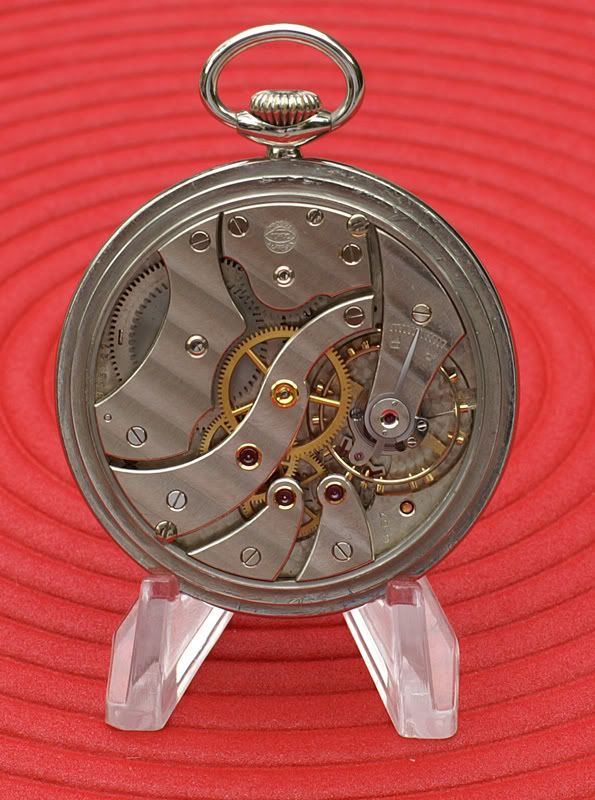
Movement looks like a calibre 67 to me. Dial seems original to me - but this is an amateur opinion. Originality of hands I'm not sure.
do take a look here: iwcpocketwatch.com/cal_67.html
also:
Hi,
Closeup pics of the dial, casing, movement would help, if u could share them here on this forum.
The case number and movement number will also assist greatly. For pocket watches, to see the movement number you would need to open up the back of the pocket watch, which a good watchmaker can do for you without harming the timepiece.
Erstwhile, these below can assist for vintage / older watches:
DateYourIWC by case and movement number (I prefer the applet version at the bottom), created by Marco Schönenberger
Vintage Catalogs may contain your target vintage watch and provide details therein.
Instructions found here on how you can also order an extract from IWC archives to verify authenticity.
Visit our moderator Michael Friedberg's excellent website on pocket watches, and compare both the dial and the movement designs. Many pocket watches have similar dials, so you may wish to look more for similarities in movement design. -
Graduate
thanks Shing
that worries me the hands dont seem to fit
I will try to get numbers to help me -
Master
Hi,
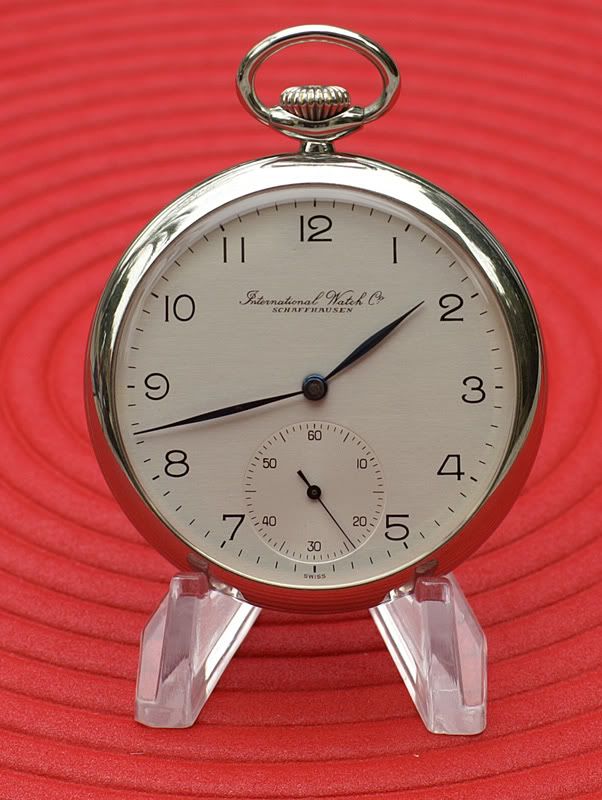
it's impossible to determine wether the dial is good by that distance, hours and minutes hands maybe replaced, since this tipology usually has leaf hands but I could be wrong. Not a big problem anyway, they can be replaced later on, with some patience.
Just another amateur opinion.
-
Graduate
ok
so what is your suggestion I should spend on it to be safe
they are asking 500 euro? is this fair -
Master
If the dial is original as well as the rest, the price is fair.
Use the "Date your IWC" tool to check coevality between case and movement and post a close up of the dial if you please.
Comments from the experts (the best in the world) will come to help you out.
-
Graduate
thanks guys for all the help
great forum here :) -
 Master
i believe michael friedberg (the moderator) will be your expert in this instance! good luck, vinhthang
-
Graduate
I am no expert on IWC, but I think the hands and face are original. Looks good to me.
Dial should be porcelain?
and $500 is about right..
Nice movement, i think Cal95/97 17 ligne 17J or caliber 67 18lig.regard
-
 Connoisseur
Adam --to my knowledge no 20th century IWC dials were porcelain --it's too fragile. This one would either be enamel or painted brass.
It's a Calibre 67; this style with such a dial was quite popular in the late 1930s for these movements (and this example has better finishing --Geneva stripes-- than many others). I would guess this one is early 1940s.
-
 Master
2 similar IWC models from the 40-th with a C.67.
Regards
HEBE
-
Graduate
great info thanks guys
the owner will give me serials too she doesnt live in my hometown
and watch is inherited from her father
feeling more confident to get it
thanks
zoran -
Graduate
Hi Michael
What do you define as 'porcelain' versus 'enamel'I think it is my bad terminology
To me dials started as 'porcelain' that is a translucent ceramic material (strong), fired at low temperature, then glazed and fired at high temperature
The result a beautiful in most cases a very white , crackable material. But impervious to sun light.Enamel is a similar technique. For a dial it uses thin plates of copper, covered in enamel, then fired, the enamel then adheres to the metal. Still crackable and impervious to sun light.
So you are correct to say enamel, while I have used porcelain.
So I say a 'porcelain' dial versus a 'metal' dial, rather than an 'enamel' dial versus 'metal'
Sorry if I confused people.
Regards
-
Graduate
I am sure this is clear for most of users here but just to be sure
lets make this clear:
enamelis basically glass on metal
en.wikipedia.org/wiki/Vitreous_enamel
porcelain is a hard fired clay body
en.wikipedia.org/wiki/Porcelain
both can be white :)
but metal dials are engine turned- Guilloche, metal dials or so
en.wikipedia.org/wiki/Guilloch%C3%A9
all three of these processes were or are used in watch/clockmaking -
Connoisseur
The trouble with Wikipedia, aside from sometimes amateur contributions, is that one can look up words or concepts out of context. In watchmaking, dials usually have precise meanings. Jack Forster, a good friend, once explained the differences in dials as:
"Watchmaker artisans today can draw on a wide range of traditional and modern techniques and materials, but which is which? The names are, confusingly, sometimes used interchangeably but each means a particular method and medium.
[b]Enamel[/b] –true enamel is also known as “vitreous” (glassy) enamel. An extremely ancient technique dating back to ancient Egypt, vitreous enamel uses finely powdered colored glass, which is applied to a metal backing. The enamel is then fired in an oven hot enough to melt the glass, producing an even, transparent or translucent surface.Porcelain –a ceramic medium. Porcelain, like enamel, undergoes some vitrification when fired, but the material itself usually contains a significant percentage of clay and other materials, unlike vitreous enamel which is pure glass. Must be fired at a much higher temperature than most other ceramics to achieve vitrification (the formation of glass in the ceramic body.)
[b]Cold Enamel[/b] –epoxy resins, which can be produced in a tremendous range of colors and transparencies. Much used in horology in the production of fine art painted dials as well as translucent colored surface treatments. Much less brittle than vitreous enamels and do not require firing to harden.But even these categories reflect over-simplications. And, also, not all (in fact not most) metal dials have guilloche or engine-turning.
The base of most fine watch dials in the past 100 years, aside from speciality items, is brass. Porcelain is seldom used, and not for IWC during this period.
-
Graduate
sure i agree thanks Michael
i just dropped some links i could find fast
I did potery, goldsmithing and engraving and finished school for mechanical engineering
so this practices are well known to me
but these days if its not on iphone people dont know it
thanks Michael -
Graduate
[b]Enamel[/b] –true enamel is also known as “vitreous” (glassy) enamel. An extremely ancient technique dating back to ancient Egypt, vitreous enamel uses finely powdered colored glass, which is applied to a metal backing. The enamel is then fired in an oven hot enough to melt the glass, producing an even, transparent or translucent surface. [b]Cold Enamel[/b] –epoxy resins, which can be produced in a tremendous range of colors and transparencies. Much used in horology in the production of fine art painted dials as well as translucent colored surface treatments. Much less brittle than vitreous enamels and do not require firing to harden.Agree
My bad terminology, as I was 'thinking' enamel for colored miniature enameling
But yes for the dial it IS/was enamel.Thanks your correction
Adam
-
 Master
For comparison, another similar calibre 67 from 1936.
D.