Hello.
I have purchased a small portiguese, and wanted to know how many units were made.
Could you tell me things about.
Thanks
Small portuguese 3531
- 13 replies
- last reply by ruli2 18 Sep 2014
-
 Graduate
 -
 Master
The number produced has not been disclosed by IWC. There was a fair bit of enthusiasm for this watch as a search of the archive will reveal (click on the magnifying glass on the bar at the top of the screen).
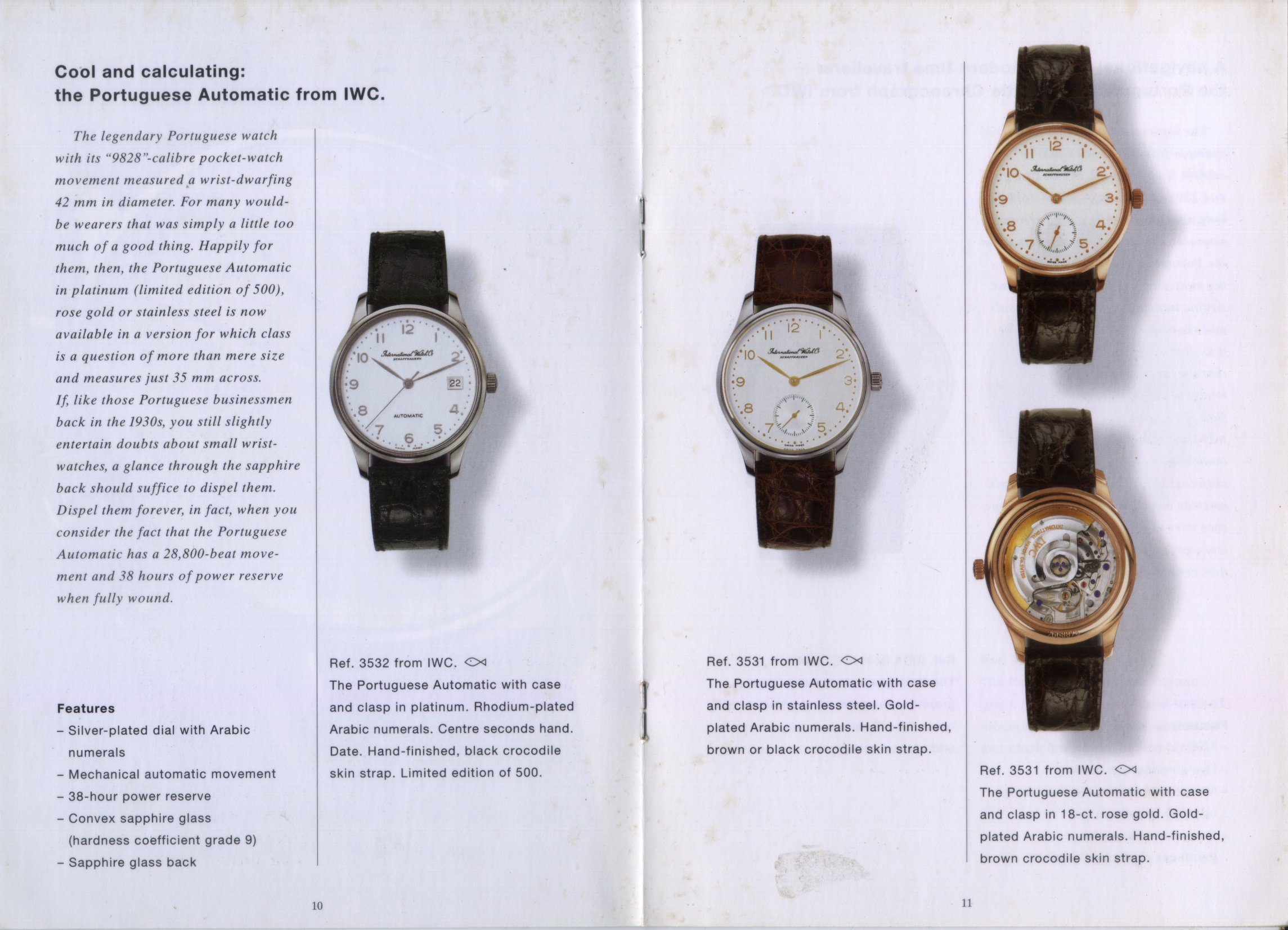
From an IWC brochure
And the dealer sheets
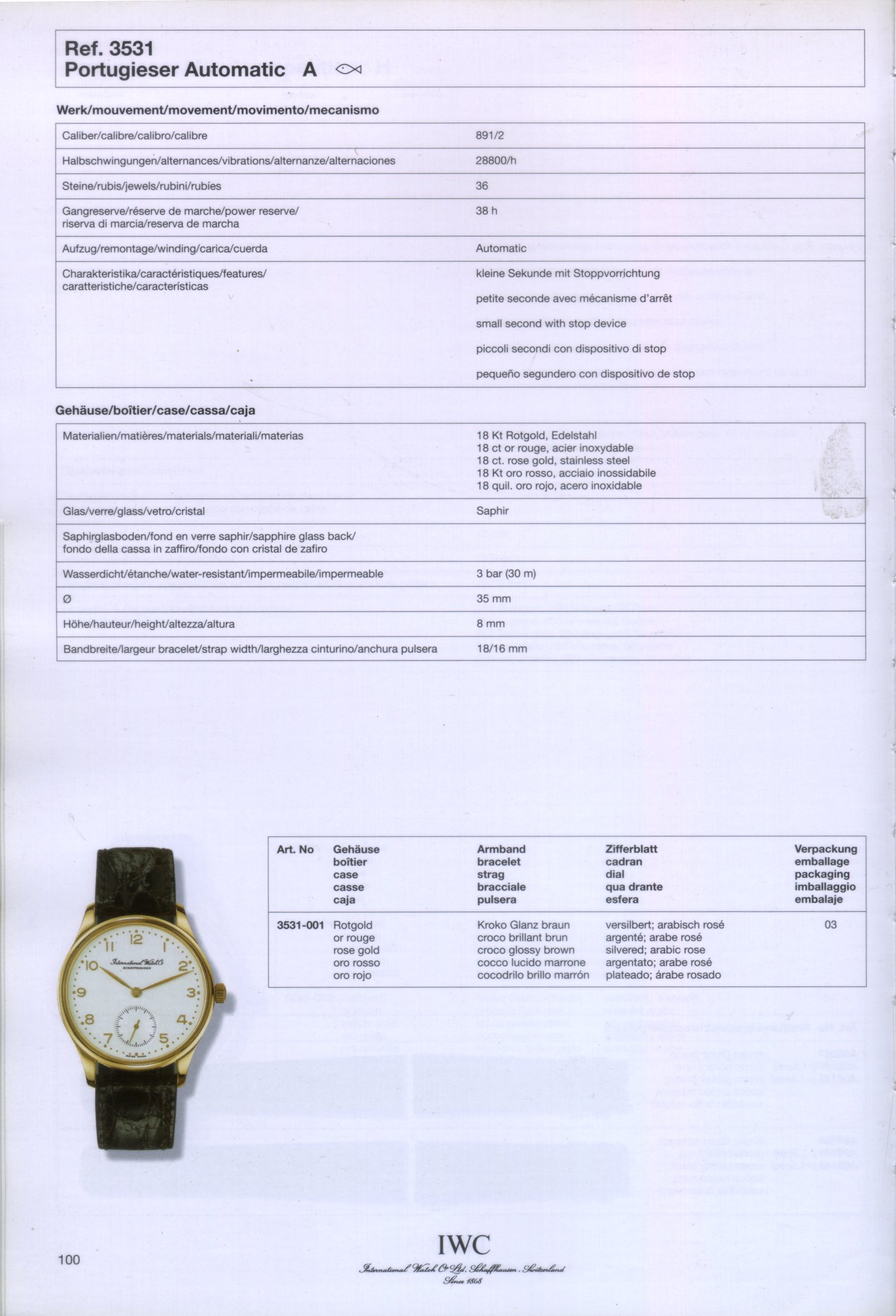

Cheers from the cellar
-
Graduate

Thank you very much.
I do not tolerate large watches, and I had long been searching for the small portuguese.
A fellow who had the watch kept in its box for 15 years, sold it.
I am very grateful.You think that the indices are applied or printed?
A greeting and I'll put more photos. -
Master
The indices and the small dots between them have been applied as was done in its larger sisters from the era ( with the exception of the limited Pisa Portugieser). Here the numerals were painted (or printed).
The movement is from JLC and very interesting is the automatic winding system,being not the Pellaton system but consisting of several wheels that can shift depending from the position of the movement and turn in 2 directions.
Kind regards,
Adrian
(alwaysiwc). -
Graduate

Thank you very much.
The manufacture and placement of small indices is very difficult.You think that the indices are placed by hand?.
-
 Master
Well, I am not sure, but I checked a 3531 dial and it looks like welded ?!
My trend is, it was mashine made.
Regards
HEBE

-
Graduate
Thank you very much.
It seems that the indices are welding.
But the dials were not manufactured in series because the position of the numbers on the dial is different from your picture to my dial.I see no sign of small dots,the more difficult work .
regards -
Master
Really ?!
I can see no difference !
Maybe the old photo ?!
This photo is new and such dials were used by other brands too.


-
Graduate
The dial numbers are very attached, and are too fat.
I think they are no different origins.
Regards -
Connoisseur
The first Portuguese of 1939 introduced a new method of dial manufacture to the IWC production line. Rather than painting, printing or applying the indices after the dial was painted & lacquered, they were stamped into the dial from behind(for numbers)and milled into the front(for dots) before the painting and finishing processes.
When IWC started to release watches under the Portuguese name in about 1995(3712 split chrono with 3714 + 3531 a few years later) they were very proud of reintroducing this method of dial manufacture for the line. This process can be seen in HEBE's excellent 'back + front' dial images.
This method of dial manufacture has been gradually phased out so replacement dials fitted by IWC will now have applied indices.
Leo -
Graduate
There is a very good review of the Portuguese 3531 by Walt Odets on Timezone. We have one which I share with my wife as it is the perfect size! Perfect style and we love it.
-
Graduate
My portuguese needles are slightly discolored, it is difficult to see. The dial is perfect.
you'd do a service for needle exchange or'd keep it like this to let age together.
Thank you . -
 Master
P.S. The center seconds version was limited to 500 Pieces...
(But the question is, if wic can be called Portugieser, watch which normally have "small seconds"Kind regards
Ralph
-
Graduate
Hello again.
I continued asking questions about iwc 3531.
The caliber 891/2 is similar to the jaeger 896 of the master ultrathin.
You know how they put the seconds in that position, you can display a photo, I can not finds it.
Thank you.