Does a "sport" watch justify any other complication apart from a chronograph? Or, in other words, can complex micromechanics be intertwined with big and extravagant cases?
The way I see it, any watch that tries to impress with size and not with engineering or design, has lost the game from the start. For example, take the Reference 3791, the new Spitfire Perpetual Calendar: A massive pilots watch (46mm/17,5mm) with a Perpetual Calendar complication. It is impressive to look at, impressive to wear (with jeans?), but not so impressive as a theoretical construction and not what comes to mind when I think of Haute Horlogerie. I know the mechanics are strong and elaborate, I know that this is a powerfull instrument of Time on my wrist, but I don't care. Why? Probably because if I want a Perpetual Calendar, I will go for the Reference 5032 any day of the week. It is in a better case size, it can be worn with a suit and with jeans and basically it knows what it wants to be. In comparison the Spitfire PC is a pilots watch that wants to be something else.
If the tradition of IWC demanded PC on pilots watches, or any other model from the "sporty" side of the lineup, then OK. But I don't think it did. There are of course other watch manufacturers that do the same thing, but that doesn't meen that whatever the competition is doing is correct.
I always believed that tradition and innovation can go together, but one must draw a line when the rules of the market overthrow the rules of the game.
A sport watch - in this case a pilots watch - can have a chronograph, a power reserve, day/date, second time zone, maybe even have a 46mm or 48mm (Reference 5029) case. But when you add a PC on top of that it feels a bit out of place and out of touch.
Sport watches & Complications
- 16 replies
- last reply by RomanGS 9 Nov 2012
-
 Graduate
 -
 Master
Romans, I will respectfully disagree with you. Some of the most sought after BPs are the PC versions. A number of these started out as limited editions for specific ADs. Think of the Piza, Wempe, and Bucherer to name a few, these ADs heard from their clients that a BPPC would be of great appeal and IWC listened to their customers. I would guess that IWC did some extensive research about the Spitfire PC before investing in it's development. Now, only the marketplace will determine if it is a success. I for one think it will be.
Regards,
Kevin -
 Connoisseur
OK...that's your opinion. Obviously many others disagree, and the market in general votes against your opinion. That doesn't mean they're right or you're right, but it does explain why IWC makes many different models of watches, as do other companies.
I'm not sure why you refer to "the rules of the game". They certainly are your rules, and they seem to me to be based on your definitions. Personally, i think wearing very expensive mechanical watches for any real physical sports activity can be dangerous to the watch. ;)
-
 Master
here's my personal opinion - having this piece below, I agree the digital date month complication is a bit out of place in a pilot-themed watch.


but... with respect to engineering - the digital date month complication is a phenomenal complication. so the spitfire digital date-month doesn't just try to impress with size - my personal opinion


these, personally, i feel are fitting sports watch:


but is also a pilot's watch, and the same 46mm size as the spitfire digital date-month.
-
Graduate
My opinion, and yes it is my opinion...since I am the one making the post, is that the rules of the market should not be the same as the rules of the (watchmaking) game. And if you like to look at it from a mirror perspective, the rules of the watchmaking industry can adjust or even create new rules for the market. In our time complicated watches get larger and larger in size. What I said, specifically for the Spitfire PC, is that the watch is indeed compelling and has great mechanical artistry, but tradition and innovation do not seem to blend peacfully in the dial.
I own some IWC watches and love the manufacturer over all - I especialy enjoy the Portuguese line. I can, therefore, talk about fiew things that over the time seem to take a different direction from my personal taste. Moreover, as I stated before, this is not a trend that only IWC has invested in, but other manufacturers as well. My note and comment therefore should be interpreted as a thought on the world of High Horlogerie and the tradition and values it all began centuries ago.
Finally, I know of course that when you invest, you are investing to make a profit and why not make a profit from pushing the direction of the market - since you are one of the leaders of it - towards something more traditionally innovative. -
 Master
Gentlemen,
I think this entirely depends on your definition of "Sport" as such.
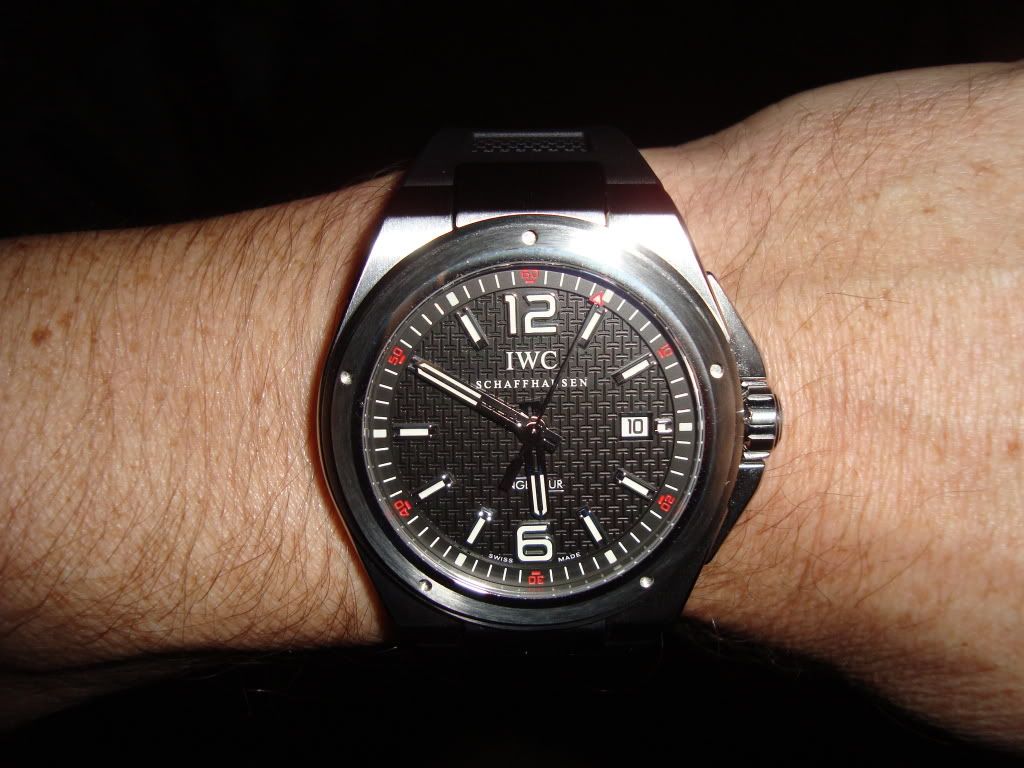
There have been chess and cricket tournaments where a Date/Day complication would have been very useful :-) Apart from that, to me a "Sport" watch means a watch that I can wear all day and don't have to think about dents, scratches and severe damage, which excludes ( I don't own one but I am sure they are very sensitive ) the PPC no matter in which shape they come. Market "rules" can be bent easily and I am sure IWC are doing a very thorough market research and the success proofs this strategy.To me, this is a fine example of a "Sport" watch:
-
Graduate
SINCLAIR, you are absolutely correct in this. When I say sport watch, I don't mean a watch that you wear while playing sports. What I mean is a watch that you can wear in a more casual manner and attire. A watch that you don't have on your wrist at work with a suit, but rather on weekends and vacations. A perfect example from the IWC pilot lineup this moment is the Reference 3878.
Cheers!
-
 Connoisseur
Dear Romangs:
A fascinating commentary! It goes without saying that complications are a matter of taste. One noted Swiss watchmaker, Franck Muller, bills himself as the "Master of Complications," while other brands (like Rolex) appear to steer clear of complications for their own sake. IWC seems to adopt a middle course, offering pilot's watches with only the day and others with special features galore.
Regarding the perpetual calendar complication, my unvarnished opinion is that it is a bit silly. I can see needing to consult a watch for the day and perhaps even the month, but if the wearer doesn't know what year he's in, he needs global positioning more than he needs a writswatch.
Cheers!
Donald
-
Master
I understand why people want to categorize watches. But what is the point? I have worn a "dress" watch in casual settings and an Aquatimer with a suit. It's my choice.
As long as I don't go swimming with my 5001 I am happy. -
Master
Watches are fun, any effort to set up boundary poles is useless - imho.
-
 Master
This is why you have more than one horse in a horse race. You, individually, pick the winner and loser. No one is right or wrong. It's what you like that matters. I wear my RG Portugieser and PPC both as a dress watch and for more casual occasions.
-
Master
There is a serious flaw in statements about what a wearer does or does not need from a watch. The reason is that we no longer need watches. Any number of other devices -- simpler, cheaper and more accurate -- can perform all of the functions of a watch and then some. I can't speak for others but if I were to get a perpetual calendar watch, it wouldn't be so that it could tell me the year or the phase of the moon but because of my appreciation for the incredible mechanism that makes those things possible. Come to think of it, that's why I wear mechanical watches to begin with.
As to whether or not a pilot's watch should have a PC, why not? Pilot's watches stopped being necessary aviation instruments a long time ago. Today the term refers to a style. So why the need to limit the features of watches in that style?
-
Connoisseur
One more thought....early on, including on this forum, I expressed the view that "tool watches" shouldn't be gold. I've since felt that was one of my greatest errors of opinion.
Sure, a real tool watch isn't gold --but when is any expensive mechanical watch today exclusively, or really at all, a tool? There are better and cheaper timekeeping tools today.
I love my gold St. Exupery chrono. I'm not going to use it to fly other than as a passenger in a commercial jet, let alone in a vintage plane's cockpit. It's a great watch. I'm not going to dislike it because it doesn't meet some definition. And likewise I wear my Portuguese Pure Classic with jeans --it's just fine then too.
-
Master
I like rules, to play with. Quite some rules were made to establish some order and progress in a chaotic world. In the beginning most people adhere sometimes vehemently to the rules, then, some flexibility grows out of this stern and maybe disagreeable situation. Examples: music, food, chess. And watches too? For me watches are fun, and being expensive, to be taken seriously too. They are about personal taste. I really like to wear my Spitfire Chrono and Portofino 8 Days Handwound when being casual. They just lend class to the situation, I like that. I saw a sporty looking gentleman at Trockener Steg (Switzerland) walking in some stony landscape wearing a rose gold Portuguese Perpetual Calendar, and was seriously impressed. And that is what it is all about, enjoying the moments, the watches.
Kind regards,
Paul -
Master
I love a "sport" watch with some complication. The GST Perpetual has been a favorite for years. As I remember in one of the original IWC magazines there was an article about the GST showing a man riding his racing bike with his titanium GST Perpetual proudly displayed!
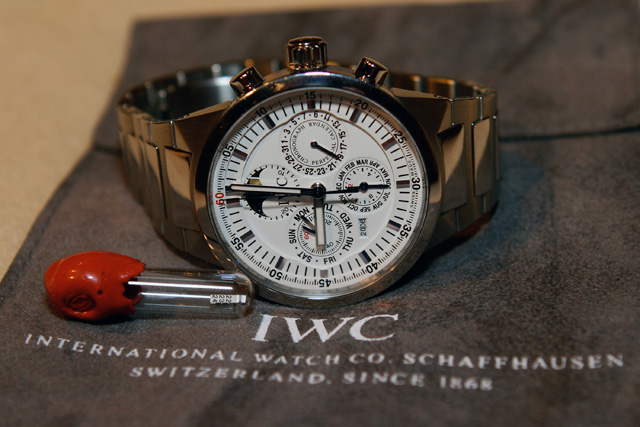
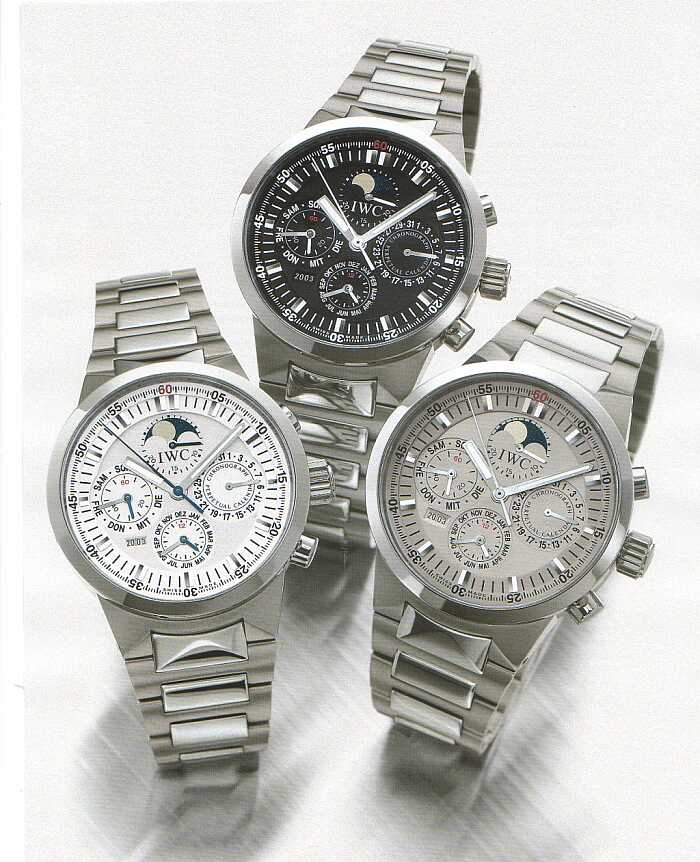
On another note: Shing, That platinum DaVinci Perpetual has got to be one of the most beautiful IWCs I have ever seen. I never tire of seeing your photos.
-
 Master
Plus, rules are made to be broken.
Where I live in California, it is not unusual to see folks in a sports coat (no one, except those in the financial industry wears a suit anymore) wearing G-shocks and CBP (cheap, black plastic) watches. Rolex Subs et al, go with anything and dress watches (whatever that is) are worn with just about anything. Since I own more watches than days in a month, I try to be traditional, but then my "dress" watches don't get worn very much, although I love them since they are the most classical timepieces in my collection
-
Graduate
For the sake of the argument I will state this: I will never understand a wristwatch of gigantic proportions, that is a 50mm case or more - some manufacturers indeed produce wristwatches that are better used as desk watches or pocket watches. An ideal case size, for our time, is 40mm - 42mm (that is why the REFERENCE 5001 from IWC is one of the most beautiful watches produced the last 10 years or more). On the matter of complications, I also believe that case size and material used is critical for the balance of the watch as a hole. How can a tourbillon be appreciated in a stainless steel case? It seems as the complication is undermined by its surrounding environment, like exhibiting a Monet in a garage.
If price is the matter, since a tourbillon watch is expensive, and then the manufacturer tries to open up the market of tourbillon watches to a wider public by bringing down the price with using steel and not gold or platinum, then again the notion of uniqueness goes down with it. Hence the argument for sport watches and high complications (Perpetual Calendar, Tourbillon, Minute Repeater).
Many great wristwatches have come in steel cases, but when one has a variety or a collection, one must also appreciate the higher standards and components of each watch individually. I prefer seeing a PC in a 42mm gold case and I would appreciate it even more as such...Have a great weekend to all!