There was a reason, which was unrelated to fashion, why the Ref 325 is a large watch - accuracy. In 1939 Mr. Rodrigues and Mr. Teixeira wanted a wristwatch as accurate as a pocket watch, hence the cal 74 and later the cal 98.
Square is beautiful.
- 28 replies
- last reply by GregoryChalk 18 Apr 2015
-
 Master
 -
 Connoisseur
Agree with this 100%. Form and function should be equally balanced to achieve supreme elegance.
-
 Connoisseur
Hi Greg, the watch at that time was the slimmest on the market, with a movement height of 1.6mm, here I copied out of their description.
The 1003 MovementIn 1951 reference 4601 is launched using a calibre only 1.31mm thick. The same year calibre 1001 is launched having a 2.94mm thickness.
One year later, in 1952, Vacheron Constantin took a decision that would change the perception of the brand for future collectors and become its signature: to make the world’s slimmest wrist watch movement. It was launched during the Basel watch fair 3 years later for the brand’s bicentenary in 1955 under the name 1003. Its 9 lignes or 21.05mm diameter and 1.64mm thickness made it at the time the world’s thinnest manual winding movement on the market. It was housed in 3 watches launched specially for the occasion, three round and one form.
The thinness of the watch could possibly lead to it being bent if it was tied too tightly to the wrist and therefore to prevent such damage, 2 screws higher than the others acted as safety to prevent the case from coming into contact with the movement. At a later date the movement was placed in an inner titanium cage to avoid any tension and prevent any possibility of the movement being bent.It is interesting to note that with the original caliber 1003 of 1955 the engineers and watchmakers had decided to do without shock protection on the escape wheel as to maintain the thinnest execution possible; however in the early 90s watchmaking techniques enabled the addition of shock protection without increasing the calibers height.
To maintain limited thickness the pallet lever is on a lower level than the fork horn and as such the pivots and jewels are also on a lower level.
One surprising feature of the caliber 1003 is its large sized balance. Surprising, because a large balance uses more energy and slim calibers with the size of their mainspring barrels have shorter lasting power reserves and it would have been logical to have a smaller balance which uses less power however considering the difficulties of regulation of such a slim caliber the larger balance provides better accuracy.
Another modification as to keep the slimness of the caliber relates to the lack of impulse roller, the impulse jewel is placed directly into the balance arms.
Extra thin watches became not only a signature of Vacheron Constantin but almost a curse! The brand was only associated with round classical extra thin watches for decades. Imagine between 1955 and 2010 there were over 850 different references (pocket and wrist watches) using this calibre!
Here again the Movement in all it's glory;
1003 Movement -
 Connoisseur
I have a very slim square Patek Friday m the early 1950s, shown here:
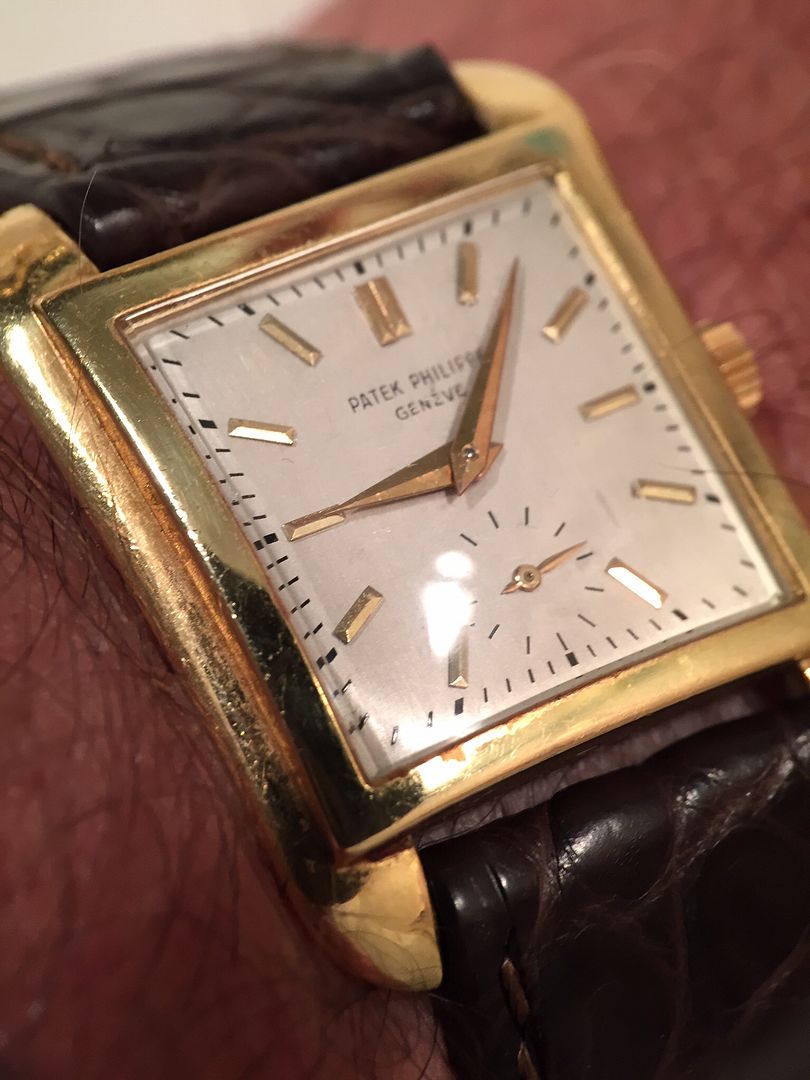
It has a "cioccolatone" case (an Italuan collectors' term for the Vacheron design shown by Sunflower that mimics a box for chocolates). But even though it is only 31mm it wears much larger --there's a difference in mass between a square and a circle.That said, I think we all need to get back to the topic of IWC, me included! :)
-
 Graduate
As requested, bringing the topic back to IWC.
The dial a bit faded, but still fairly decent.
-
Master
Thanks for sharing. What is the movement inside that beautiful art deco design.
-
Graduate
According to DateYourIWC,
"The movement is a calibre 62, dating from the year 1939."There is a similar watch being sold by a European seller except
that one is said to be stainless steel and NOS.
The dials are strikingly similar.Here is a pic of the movement.
(I have masked the last digits of the movement)
-
 Connoisseur
This has been a great thread. Wonderful watches you all have posted.
-
 Master
 -
Connoisseur
That is very elegant.
-
 Master
What a nice piece....
thanks for sharing
Ralph
PS. All other "Squares" are also very nice...
-
 Master
Enjoyable and educational thread, I am not normally a lover of square watches but there are pieces in this thread that I do like a lot.