
• Apprentice
    2 Jun 2026, 11:42 a.m.

    Hello everyone,

    I recently acquired an unusual IWC Ref. 5450 Vollkalendarium Mondphasen from the 250-piece limited series. This example is marked No. 072/250 on the movement.
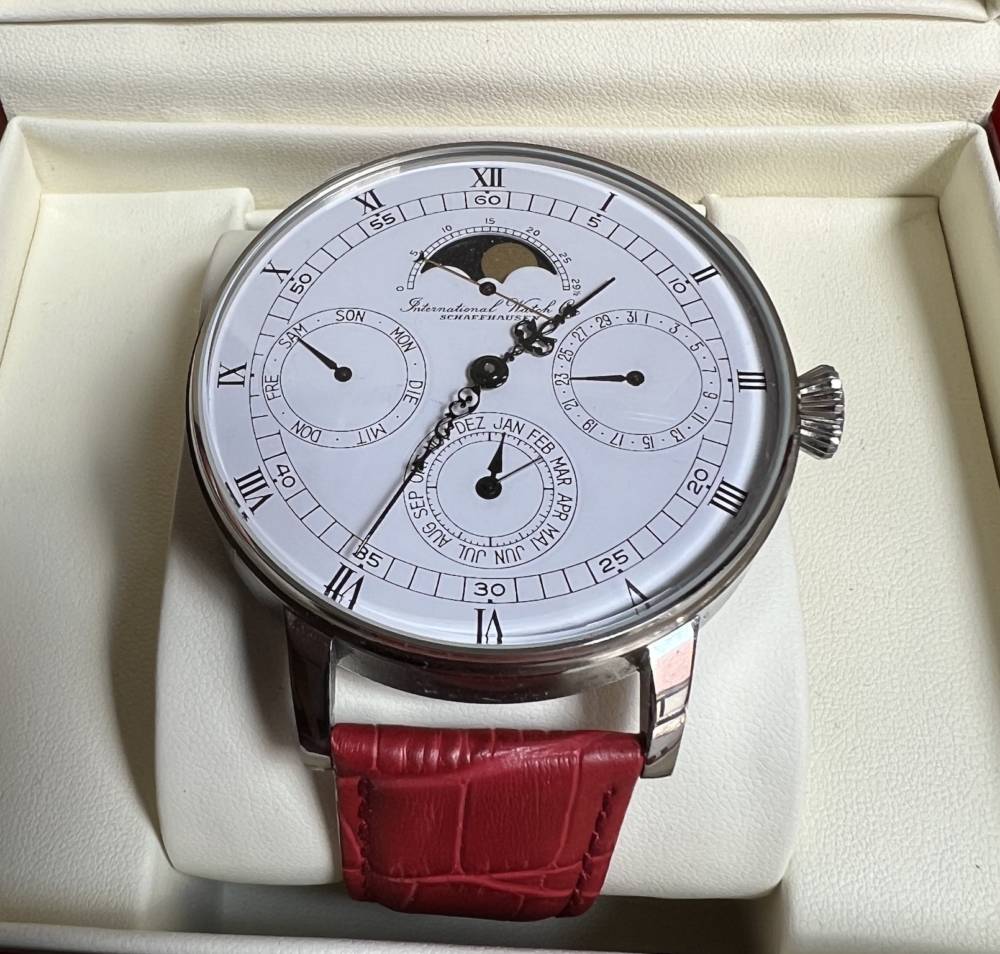
    I am not an IWC specialist, so I would be very grateful for corrections, additional information, or any observations from more experienced collectors here.

    As far as I understand, the Ref. 5450 was originally produced as a limited 18k gold hunter-case pocket watch, fitted with the Cal. 9821 full calendar and moonphase movement. I understand that this calibre is usually described as a gilt bridge movement with elaborate floral engraving.
    I have also seen the Cal. 9821 in this full calendar and moonphase configuration described by some auction houses as a 31-jewel movement, but I would be grateful if someone could confirm the correct jewel count for this exact version.
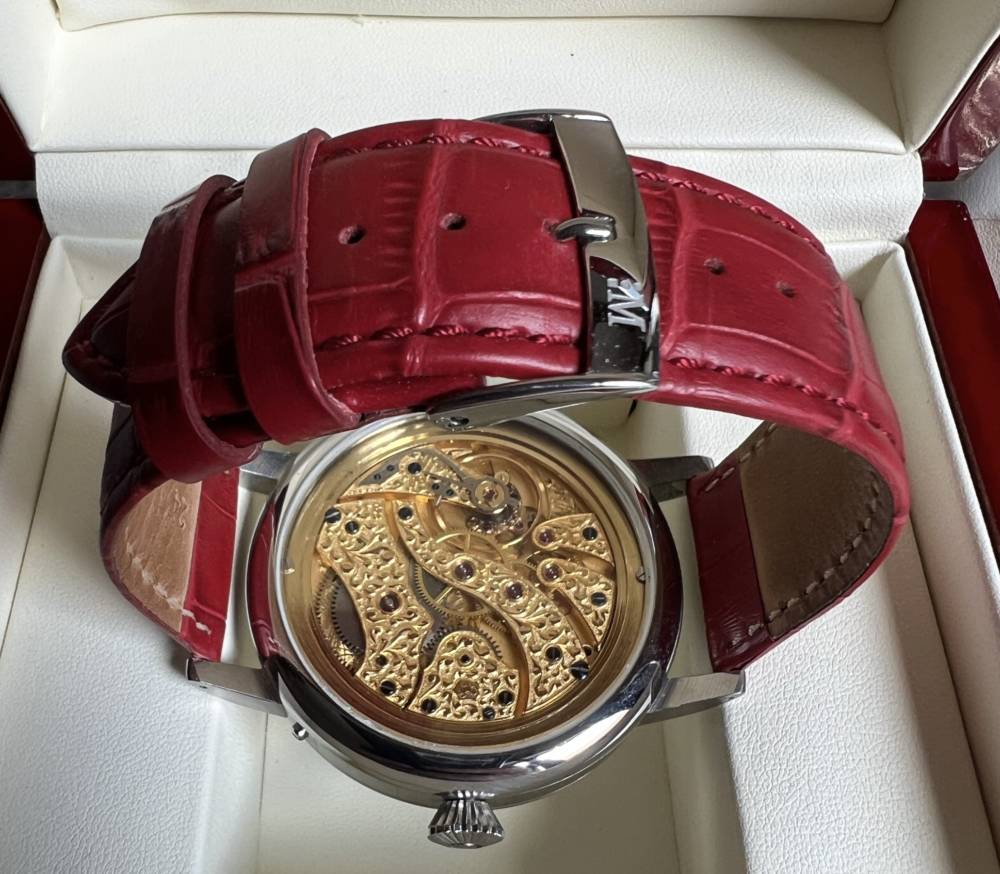
    To be clear, this example is no longer in its original gold pocket watch case. The original gold case was already missing before my ownership. What has survived is the numbered movement, the enamel dial, and the full calendar and moonphase mechanism. These are now housed in a custom 50 mm wristwatch case, with the calendar correctors remaining functional.
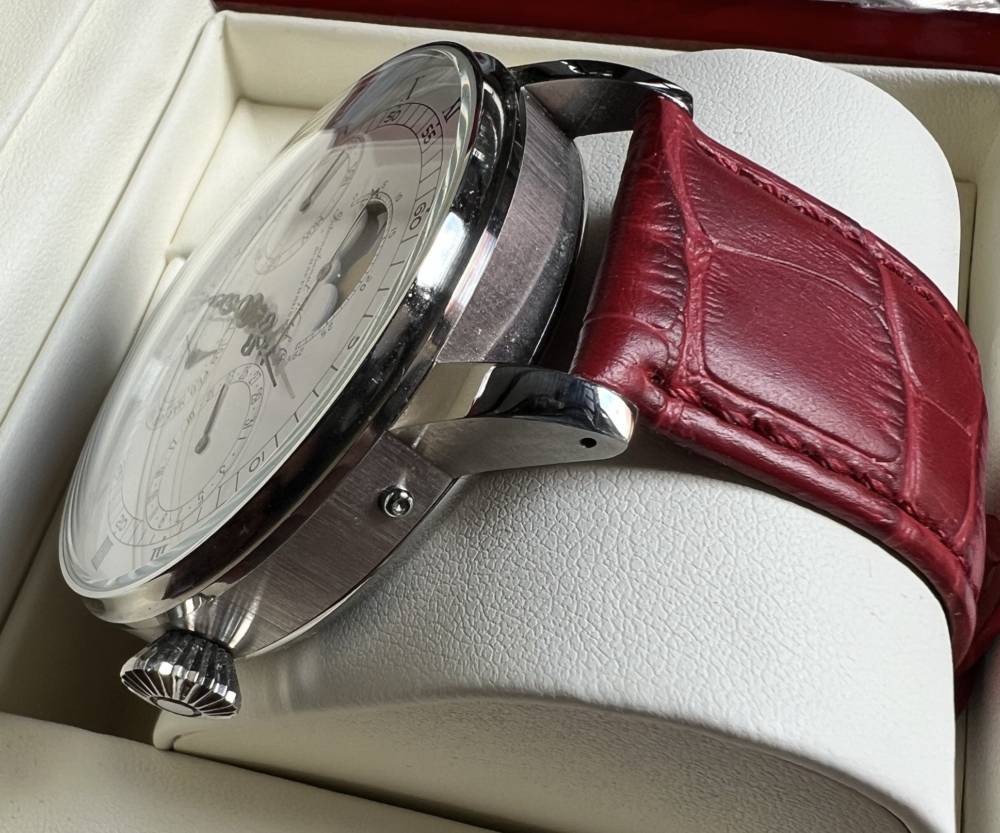
    What I am trying to understand is how unusual this configuration may be.

    My simple reasoning is the following.

    Out of the original 250 pieces, many surviving examples would presumably still be kept as original gold pocket watches. Those would normally not be re-cased as wristwatches, because their original configuration has obvious collector value.

    Then there may be a smaller group where the original gold case was lost, removed, melted, or separated from the movement at some point. But even in that case, several things would still have had to happen for a watch like this to exist today:

    1. the movement had to survive,
    2. the enamel dial had to survive,
    3. the calendar and moonphase mechanism had to remain complete,
    4. the movement had to avoid becoming a parts donor,
    5. someone had to recognise it as worth preserving,
    6. a custom wristwatch case had to be made for it,
    7. and the calendar correctors had to be properly integrated.

    There is also the size issue. Since the movement comes from a large pocket watch, the resulting wristwatch is around 50 mm. That makes it wearable only for a fairly small group of people with larger wrists, or for collectors who specifically enjoy very large, sculptural watches.

    For these reasons, I wonder whether properly re-cased Ref. 5450 examples with functional calendar correctors could be extremely rare — perhaps even in the single digits worldwide. But this is only my impression, based on the limited production number and the practical difficulties involved.
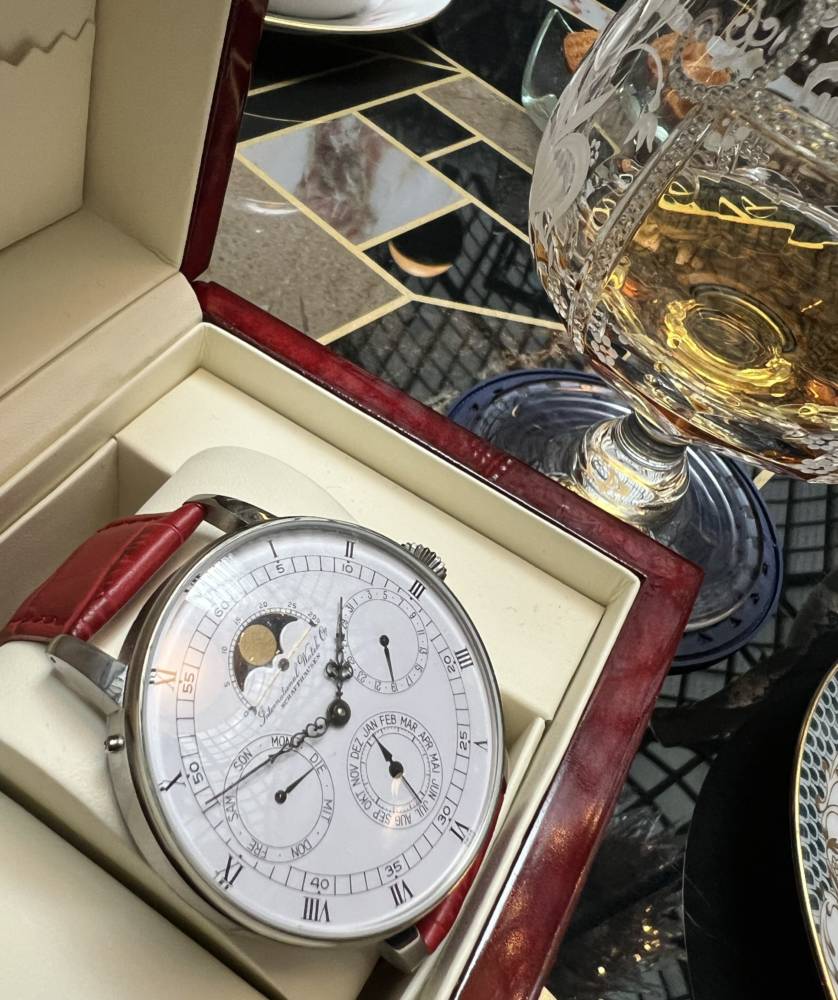
     

    Has anyone here seen another Ref. 5450 re-cased as a wristwatch, especially one where the calendar correctors remain usable?

    I would be very grateful for any documented examples, auction references, archive information, or collector experience.

    I am sharing this primarily for historical and collector context, not as a sales post.

    Best regards,
    George

  • 3 Jun 2026, 8:29 p.m.

    never saw one before, maybe because people like to keep it original with the pocketwatch case. Could be a melter, but then why not go for a simple caliber, the gold weight is the same or similar, but you don't pay for the special caliber.

  • Apprentice
    3 Jun 2026, 8:44 p.m.

    That is exactly what makes the story so interesting to me.

    Perhaps at some point someone looked mainly at the gold value of the case and did not fully recognise the importance of the movement itself. In that sense, the loss of the original gold case is the tragedy of the watch.

    At the same time, the great luck is that the numbered movement, dial, calendar and moonphase mechanism survived. The movement did not become a parts donor and did not disappear. It was preserved and eventually given a new life in a wristwatch case. I see it as an interesting survival and preservation story.

  • Insider
    4 Jun 2026, 9:15 p.m.

    Hi georgezabo,

    it is out of question that this movement belongs to a pretty special and rare pocket watch. As you stated, most probably it was stripped of its gold case. At todays gold price this seems tempting for a quick monetary win. However the complete watch would have brought more cash in an auction. I guess that the slaughtering of such a rare piece is pretty uncommon. 
    br Cromagnonman

  • Master
    6 Jun 2026, 3:58 p.m.

    Or perhaps the original owner simply fancied a bespoke ww case and used the pw case to make the job easier...if they died whilst it was in ww format, things go missing.

  • Apprentice
    8 Jun 2026, 11 a.m.

    Hi Cromagnonman,

    thank you, that is very helpful.

    I agree with you. From a collector’s point of view, stripping such a rare IWC Schaffhausen watch only for the gold case seems quite irrational, especially if the complete IWC Ref. 5450 Vollkalendarium Mondphasen would probably have achieved more at auction.

    My only guess is that at some point this Ref. 5450 may have passed through the hands of someone who mainly looked at the precious-metal value of the original 18k gold pocket watch case and did not fully recognise the importance of the Cal. 9821 movement itself. Or perhaps the original context was simply lost over time.

    That is what makes the story both sad and fascinating to me. The original gold pocket watch case is gone, which is clearly the tragic part. But the numbered movement, marked No. 072/250 from the 250-piece limited series, survived. The enamel dial, full calendar, moonphase mechanism and calendar correctors also survived. The movement did not become a parts donor and did not disappear completely.

    So I tend to see this IWC Ref. 5450 No. 072/250 as a survival and preservation story. It is no longer original as a pocket watch, of course, but after the loss of the original case, the wristwatch re-casing may have been what allowed the Cal. 9821 full calendar and moonphase movement to remain complete, visible and usable.

    Best regards,
    George

  • Apprentice
    8 Jun 2026, 11:28 a.m.

    Hi Catherine,

    thank you, that is a very interesting possibility.

    Perhaps the story was not about gold value at all. The case may have been removed for a very ordinary reason: a damaged hinge, a fall, a repair that was never completed, an inheritance dispute, a divorce, or even the death of the watchmaker who had it on his bench.

    What I find moving is that, once separated from its pocket watch case, the movement was almost defenseless. A case is not only metal; it is the watch’s skin, its shelter, its first protection against time, dust, humidity and careless hands.

    Without it, the movement was exposed and vulnerable. It could easily have disappeared into a drawer, lost parts, or become a donor movement.

    But it survived. So whatever happened to the original case, I see this less as a simple re-casing and more as a small survival story.

  • Apprentice
    9 Jun 2026, 12:26 p.m.

    Dear Tonny Berteloot,

    what you wrote touched me. Please allow me to share a few lines that came to mind while reflecting on the story of this movement:

    Its golden raiment torn away,
    From first-born form it stood exiled;
    Yet, naked to the dust of day,
    Its inward soul remained undefiled.

    The movement, dial, and secret heart
    Lay bare, bereft of gilded room;
    But silence could not take its art,
    Nor seal its breathing pulse in tomb.

    What seemed a wound of loss and night
    Was turned, by fate, to stranger grace;
    A second life awoke to light,
    And time looked out with altered face.

    Best regards,
    George