Yes Adrian, why don't you post images of the Bund series?
IWC SEALS
- 90 replies
- last reply by hajothissen 18 Jan 2013
-
 Master
 -
 Connoisseur
Outstanding collection. I especially like the deck watch.
Regards,
Marinus -
 Master
 -
Insider
How about showing some more pics of the white Mark 11, Catherine ;-)
Best,
Ian. -
Master
Beautiful "fishtail" Catherine.
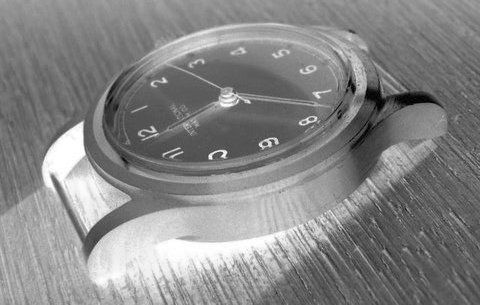
Before depicting the German IWC Deck watches or "Beobachtungsuhren", another Mk 11, used as a military watch for astronavigation but not being a military watch is shown. I am referring to the B.O.A.C Mk 11, a watch used by the predecessor of British Airlines. This watch was not very popular among B.O.A.C. pilots. The reason was that in contrast to RAF, RAAF, SAAF and RNZAF, these watches were not serviced at regular time intervals, leading to inaccuracy after a year or so. Although provided by B.O.A.C.,many pilots decided to keep the company's watches in a drawer at home. They used their own watches (Omega, Bulova etc.), as they were new and accurate. This B.O.A.C. Mk 11 has been restored at IWC completely.
-
Master
..Here is the back. The inscription of the owning pilot has been added later.
Many years ago, I was invited by IWC to attend the SIHH in Geneva. At that occasion , IWC invited us for a flight with the Juncker plain in the valley of the Geneva lake. I met an American guy on board named B.T. He knew all about military plains as his father was a US pilot on the P38 during WW II in the Far East. He told me that he was the proud owner of a B.O.A.C. Mk 11. From that moment on I molested him by sending continuously emails : I want to buy that watch. He answered that he was not interested, unless I could deliver to him the airplain in which we flew over Geneva. I gave up. About 3 years later, he contacted me telling that he wanted to sell this watch to the most stubborn IWC collector he knew : me! We got a deal and a few things had to be exchanged.
The most important of these were the "spring bars". The B.O.A.C. Mk 11 had originally "fixed bars". A well known German IWC collector told me that IWC was not able to reverse from "spring" to fixed". but he was wrong..
Here is the back side of the watch, which I have refused to be polished.
-
Master
OMG, here we go again. :)
-
 Master
Just a fantastic collect. Not just a story but the real thing!!
-
 Graduate
Para dizer a verdade,para mim, já é bom ter um "camarada" Português "maluco" por relógios...tenho sempre a sensação que somos poucos...
Abraço -
Master

The first "Beobachtungsuhr" ( wich can be best translated as "Observation Watch", is this Cal.67 watch. made by IWC during W.W. II(1944) for the German Navy , called "Kriegsmarine" or "War Navy". IWC was not the only producer and many famous Swiss brands such as Patek Phlippe, Vacheron Constantin, Ulysse Nardin and several others, made these precision watches. This has been documented in an outstanding way by Konrad Knirim in his book on military watches. As Switzerland remained neutral during the W.W.II, they could offer their watches as a smart business country to both Germany and the allied countries. And so they did! The quality of the watches for the German Navy was determined by German Chronometer Observatories located in Leipzig and Gesundbrunnen , Germany. IWC was rated as class II, being the middle class watches, although many performed as good as the class I watches from Patek and Vacheron Constantin. At a point in time during W.W. II, the German Forces needed more deck watches as the Swiss manufacturers could produce. Than, civilian cal. 67 PW's were allocated to the war equipment and rated as class III Beobachtungsuhren. From 1942 until 1944 3 series of IWC Deck watches were produced, containing 665, 2500 and an unknown amount(not published) of watches, respectively. The first 2 series had an enamel dial, the third series a full luminous soft green dial, by the way not containing Radium-226 or any other radioactive material, but the harmless Zincsulphid. Having researched for 15 years, I have never found a watch from the first series, which has been delivered almost completely in 1942 to Gerl and Schipper, Cologne, Germany. I would be very interested to know , who owns such watch. All Deck watches I have ever encountered are derived from the second and third series. The watch depicted here shows a typical, often seen damage on its enamal dial. It is no crack or hairline but it seems as if a part of the dial is lifted up : between 10 and eleven o'clock. Probably this is caused by moisture.
Kind regards,
Adrian,
(alwaysiwc). -
Master
Sorry for a typing error in the B.O.A.C post!
Not being a native English speaker I used the word "plain", while it should be of course "plane". In English they sound the same, in Dutch they are very different : lesson 1 in Dutch.( I also learned portguese in this thread)
Plain = vlakte
Plane = vliegtuig.
Hartelijke Groeten,
Adrian,
(alwaysiwc) = (altijdiwc) -
 Master
Sensational collection and a great thread! Love seeing all these together.
-
 Master
Catherine,
How can I contact you? I've been wanting to talk to you about something else for a while, but my emails don't seem to go thru. Just email me privately, if you will.Nelson (schadenfreude @ verizon.net)
-
 Master
Muito boas vindas, Kunisman, áquele que é, provavelmente, o melhor Fórum do Mundo.
Brain damage wouldn't worry me, but there is a certain IWC virus that spreads around pretty quickly, so beware... ;-)
Cheers!
-
Connoisseur
Best wishes and congrats from GE Seals, having a rest on a sand bar in the German Bight.

Excellent, historic collection!Kind regards
-
Connoisseur
[QUOTE="alwaysiwc"]
(alwaysiwc).[/QUOTE
Hi Adrian,
here is a former KM 'Beobachtungsuhr', Cal. 67 with box, which as used same application for navigation later in the Bundesmarine, see NSN.

I believe Heiko can show us a BUND ref. 5301, the last IWC TU which was used in the GE Navy.Kind regards
-
Master
Early BOAC Mark 11, with the "white 12" dial and 226Ra luminosity.
BTW, while the RAF distributed the Mark 11s to individual Navigators and Pilots, BOAC did not.
BOAC issued the Mark 11 to the flight deck crew member in charge of celestial navigation (Navigator or Pilot), as part of the astronavigation kit, only prior to a flight where astronavigation would be required. The kit, including the Mark 11, would be returned to Flight Operations a the end of the flight to be used by the next crew.
It is the testimony of one VC10 pilot that the Mark 11 became unreliable at the end of its life because of poor maintenance, and crews started using their personal watches, e.g. the Bulova Accutron tune fork, because of their superior accuracy. This is very much "out of character" for a British institution. Had BOAC showed a similar attitude towards aircraft maintenance the results would have been disastrous. I wonder why this was allowed to happen.
RAF, on the other hand, maintained a rigorous maintenance schedule for their Mark 11, which allowed them to perform as required until the early 1980s.

-
Master
The Deck watch shown by Hajo is one of the most amazing cal.67 ones. After W.W. II had ended, many of the German war ships had been sunk by the allied forces. But not all and those ships that returned had their military Deck watch on board. In stead of disposing these watches, some of them were "rescued", ready for a second life. But the Nazi Reich had been eliminated. So the military signs on watches, bearing a Kriegsmarine logo on the dial a swastica and the German Eagle on the back lid, had to be whiped out. The German Navy solved the problem by removing the complete dial, to be replaced by a plain white dial. This meant that also the IWC logo had been removed. The back lid was polished until all stamps had been fainted.
Germany became soon a member of NATO and printed the mandatory Nato Stock Number (NSN) (in German "Versorgungsnummer") on the back lid. If one examines such watch, one often can see dents in the back lid. As a result of the polishing the back lid became thinner and more vulnerable. The wooden case with own NSN number and front of plexiglass, had a fixed place on the ship. The officer of duty had to wind it each morning at the same time. Noboddy else was allowed to touch the watch. If the procedure had ended , this was registrated in a log book and signed for. A former Navy officer who has observed this, is one of our forum members : Hajo Thissen.
What we know for sure is that this type of watch has been in combat more than 65 years ago. It is unknown how many are around, as IWC played no role in the "conversion" process,meaning that there is no registration in the Archives. During the post war period these mechanical cal. 67 IWC Chronometers lost their role in navigation. More modern instruments (radar) became available. During their second life these master pieces were used as a master clock, indicating the right time, once the power supply of the ship ceased for whatever reason....
Kind regards,
Adrian,
(alwaysiwc).